

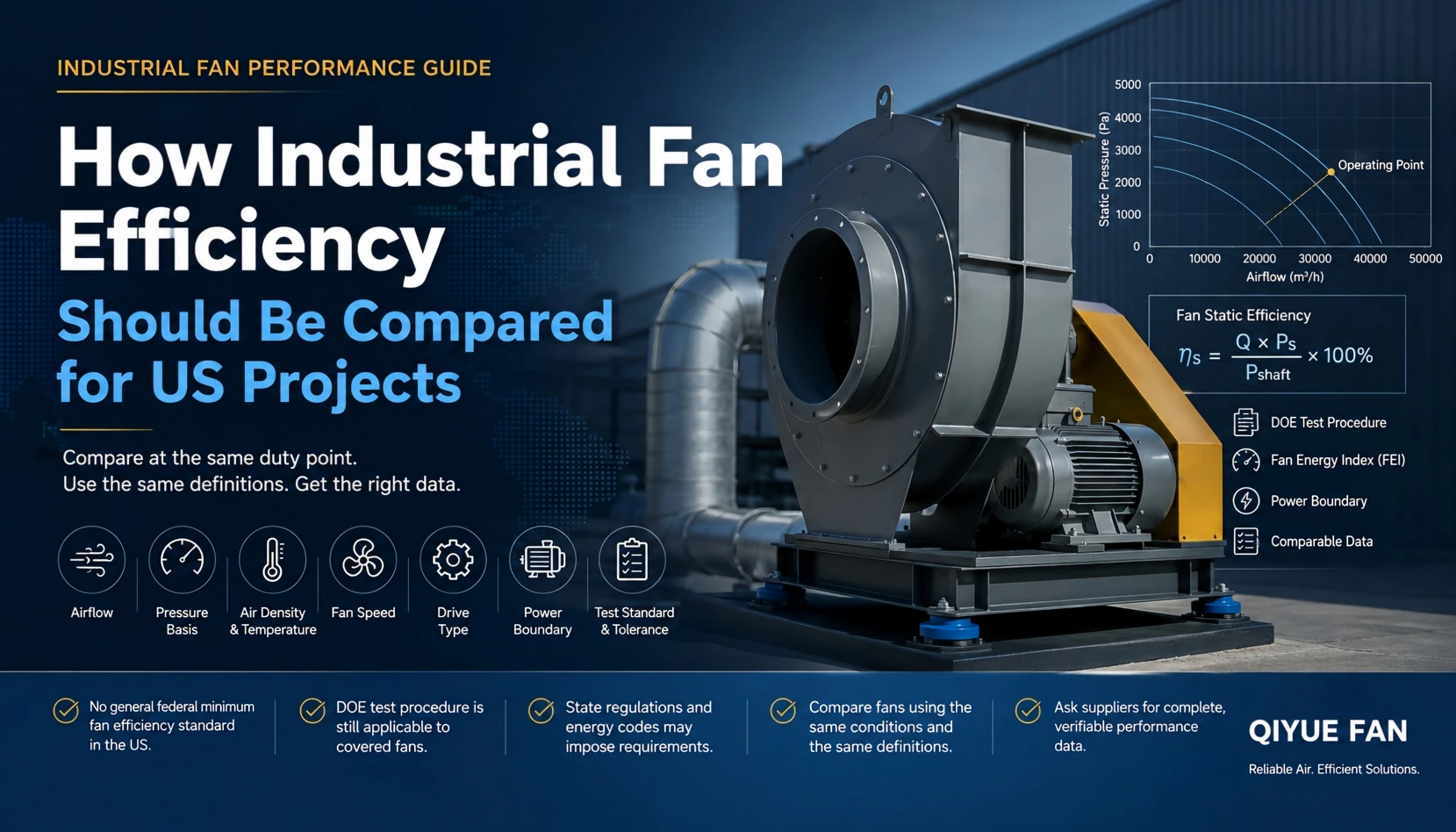
Compare industrial fans at the same operating point. Confirm airflow, static or total pressure, air density, fan speed, shaft power, electrical input power, efficiency definition, test method and data tolerance before deciding which quotation is more efficient.
What Is the Current US Position on Industrial Fan Efficiency?
Minimum efficiency standards, test procedures and project requirements are three different layers. Buyers should identify which layer applies before requesting a compliance statement or comparing supplier data.
No Current General Minimum Requirement
The US Department of Energy currently states that there are no federal energy conservation standards for fans and blowers. The previously proposed federal standard was withdrawn.
A Uniform Test Procedure Still Exists
Representations of fan energy efficiency and energy use for covered equipment should follow the applicable DOE test and calculation procedure.
Additional Requirements May Apply
California regulations, adopted energy codes, engineering specifications and tender documents may impose FEI, certification, marking or performance requirements.
Eight Conditions Must Match Before Comparing Two Fans
A higher efficiency percentage is meaningful only when both suppliers are describing the same physical condition and the same power boundary.
Same Airflow
Compare both fans at the required m³/h, m³/s or CFM, not at different maximum-airflow points.
Same Pressure Basis
Confirm whether each fan curve uses fan static pressure or fan total pressure.
Same Air Density
Temperature, altitude, humidity and gas composition affect air density and fan performance.
Same Fan Speed
Compare RPM, frequency, motor poles, pulley ratio and VFD setting.
Same Impeller Condition
Impeller diameter, blade geometry and inlet configuration must correspond to the stated data.
Same Power Boundary
Identify whether the value means fan shaft power, motor output power or electrical input power.
Same Test Basis
Confirm test configuration, measurement points and whether the data are tested, calculated or interpolated.
Same Data Tolerance
Request manufacturing, measurement and performance tolerances rather than ideal nominal values only.
Fan Efficiency Is Not One Universal Number
Static efficiency, total efficiency, motor efficiency and wire-to-air efficiency describe different boundaries. They should not be placed in one comparison column without explanation.
Fan Static Efficiency
Useful static air power divided by fan shaft input power at a defined airflow and static-pressure point.
Fan Total Efficiency
Useful total air power divided by fan shaft input power at a defined airflow and total-pressure point.
Wire-to-Air Efficiency
Useful air power divided by electrical input power, including the stated motor, drive and controller losses.
Fan Energy Index
FEI compares reference fan electrical input power with evaluated fan input power at the same duty point.
Why Motor Nameplate Power Is Not Fan Efficiency
The rated kilowatt value on a motor nameplate indicates the motor output rating. It does not directly show actual fan shaft power, electrical input power or aerodynamic efficiency at the project operating point.
Do Not Compare Only By
- Installed motor rating
- Motor efficiency class alone
- No-load current
- Maximum airflow without pressure
- Peak efficiency at an unrelated point
- A catalog kW value without a defined boundary
Compare Using
- Fan shaft power at the duty point
- Expected electrical input power
- Motor efficiency at the expected load
- Drive and controller losses
- Static or total air power on the same basis
- Operating-point efficiency and FEI where required
Why Two Similar Fan Quotations May Not Be Comparable
A lower listed motor power does not automatically identify the more efficient fan. The definitions behind each value must be aligned first.
| Comparison Item | Supplier A | Supplier B | Buyer Review |
|---|---|---|---|
| Airflow | 25,000 m³/h | 25,000 m³/h | Comparable |
| Pressure | 2,800 Pa static pressure | 2,800 Pa total pressure | Not comparable until the pressure basis is aligned |
| Air Density | 1.20 kg/m³ | Not stated | Supplier B must identify reference conditions |
| Speed | 1,480 rpm | 1,760 rpm | Different speeds change pressure, power and noise |
| Power Value | Fan shaft power: 27.4 kW | Motor rating: 30 kW | Different power boundaries |
| Efficiency | Fan static efficiency | Peak total efficiency | Different definitions and operating points |
| Test Basis | Test procedure stated | Not stated | Testing or calculation basis must be confirmed |
Data Required for a Comparable Industrial Fan Quotation
Supplying a complete operating-point definition reduces repeated communication and prevents suppliers from making different assumptions.
Duty Point
- Required airflow
- Static or total pressure
- Normal operating point
- Minimum and maximum demand
- Required operating margin
- Continuous or intermittent operation
Air and Gas Conditions
- Gas type and composition
- Operating temperature
- Reference or actual air density
- Site altitude
- Humidity and moisture
- Dust, corrosion or combustible gas
Fan Configuration
- Required fan speed
- Direct, belt or coupling drive
- Impeller diameter
- Rotation and outlet angle
- Inlet and outlet connection
- Installation-space limitations
Electrical Data
- Voltage and frequency
- Motor efficiency requirement
- VFD or fixed-speed operation
- Controller boundary
- Hazardous-area requirement
- Maximum permitted input power
Performance Basis
- Static or total efficiency
- Fan shaft power
- Electrical input power
- Required FEI
- Applicable test procedure
- Permitted data tolerance
US Project Information
- Destination state
- Applicable energy code
- Engineering specification
- Required certification
- Registration or marking requirement
- Inspection and documentation scope
Four Compliance Layers Should Be Checked Separately
The fan supplier can provide technical data, but the final project requirement also depends on equipment scope, jurisdiction and purchaser specification.
Federal Status
Check the current DOE classification, test procedure and representation requirements.
State Rules
Review California or other state requirements for covered commercial and industrial fans.
Energy Code
Confirm the code edition adopted by the project jurisdiction and any fan-efficiency provisions.
Project Specification
Review FEI, certification, motor class, input-power limit, test witness and documentation requirements.
Related QIYUE FAN Technical Guides
These pages explain the individual boundaries used in a complete fan-efficiency comparison.
Frequently Asked Questions
Does the United States currently have a federal minimum efficiency standard for industrial fans?
DOE currently states that there are no federal energy conservation standards for fans and blowers. However, test procedures, state regulations, energy codes and project specifications may still apply.
Can two industrial fans be compared by motor kW?
No. Motor nameplate power is not the same as fan shaft power or actual electrical input power. Airflow, pressure, air density, speed, drive and power boundary must also match.
What is the difference between static efficiency and total efficiency?
Static efficiency uses fan static pressure, while total efficiency uses fan total pressure. The two values should not be compared directly as if they were the same metric.
Is peak efficiency the correct value for a quotation?
Only when the required operating point is located at that peak. Buyers should normally request efficiency at the actual airflow and pressure point.
What does FEI measure?
FEI compares reference fan electrical input power with actual fan electrical input power at a specified duty point under the applicable procedure.
What should buyers send QIYUE FAN for a comparison?
Send required airflow, static or total pressure, temperature, density, altitude, fan speed, motor and drive details, project destination and applicable efficiency requirements.
Official Regulatory Sources
Regulatory status reviewed in July 2026. The latest official text should be checked before final procurement or compliance decisions.
US Department of Energy: Fans and Blowers
Electronic Code of Federal Regulations: 10 CFR 431.174
California Energy Commission: Title 20 Appliance Efficiency Regulations
Send Your Required Airflow and Pressure
Send the operating point, air conditions, fan speed, power supply, drive arrangement, project destination and applicable efficiency requirement. QIYUE FAN can help organize the data needed for a technically comparable fan quotation.
Airflow | Static / Total Pressure | Temperature | Density | RPM | Shaft Power | Motor | Drive | Destination | FEI / Standard