

Mine & Tunnel Ventilation Fans
Mine Ventilation Fans for Underground Airflow, Local Ventilation and Tunnel Projects
QIYUE FAN provides mine and tunnel ventilation fan solutions for coal mines, metal and non-coal mines, underground roadways, working faces, tunnel construction and completed road tunnels.
Selection should begin with the actual ventilation duty, required airflow, pressure, ventilation distance, duct system, mine environment, electrical standard and safety requirements—not only the fan model or motor power.
Mine and Tunnel Ventilation by Working Environment
Different mine types and tunnel stages require different ventilation duties. Confirm the working environment first, then review the suitable fan family and ventilation method.
Coal Mine Ventilation
Main and local ventilation directions for coal mine air circuits, underground roadways, heading faces and working areas where project-specific safety requirements must be reviewed.
View Coal Mine Fans →Non-Coal Mine Ventilation
Main, auxiliary and local ventilation for metal mines, gold mines, non-ferrous mines and underground engineering projects.
View Non-Coal Mine Fans →Tunnel Duct Ventilation
Long-distance duct air supply for road tunnels, railway tunnels, mine headings and underground construction during excavation.
Tunnel Construction System →Road Tunnel Jet Ventilation
Longitudinal airflow, vehicle exhaust control and smoke-exhaust support for completed road tunnels.
View Tunnel Fans →Main, Auxiliary and Local Mine Ventilation Fans
The fan position in the ventilation system determines the required structure and operating point. A main fan, booster fan and duct-connected local fan should not be selected from diameter or motor power alone.
Many of the mine and tunnel ventilation fans shown on this page use axial-flow principles. For basic airflow direction, working principle and common fan types, see axial fan fundamentals.
Mine & Tunnel Fan Fabrication in the QIYUE FAN Workshop
These real workshop photos show mine and tunnel fan manufacturing at different stages, including axial fan casing fabrication, heavy-duty structural preparation and batch production before final assembly. The images below are actual QIYUE FAN production records rather than stock illustrations.


Mine & Tunnel Ventilation Fan Product Range
Review all current mine and tunnel ventilation fan product directions. Final selection should be confirmed according to ventilation role, airflow, pressure, duct resistance, installation and project safety requirements.


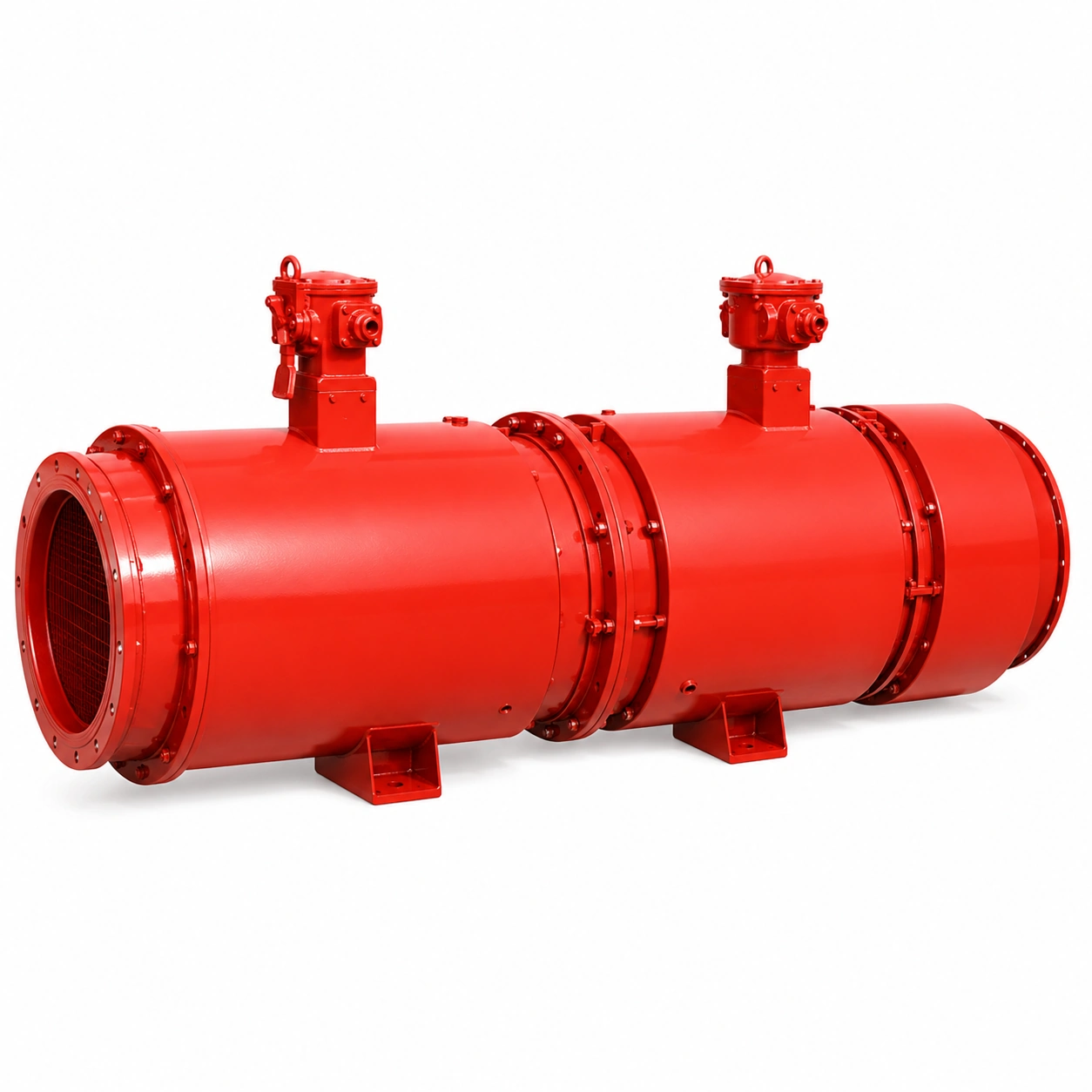

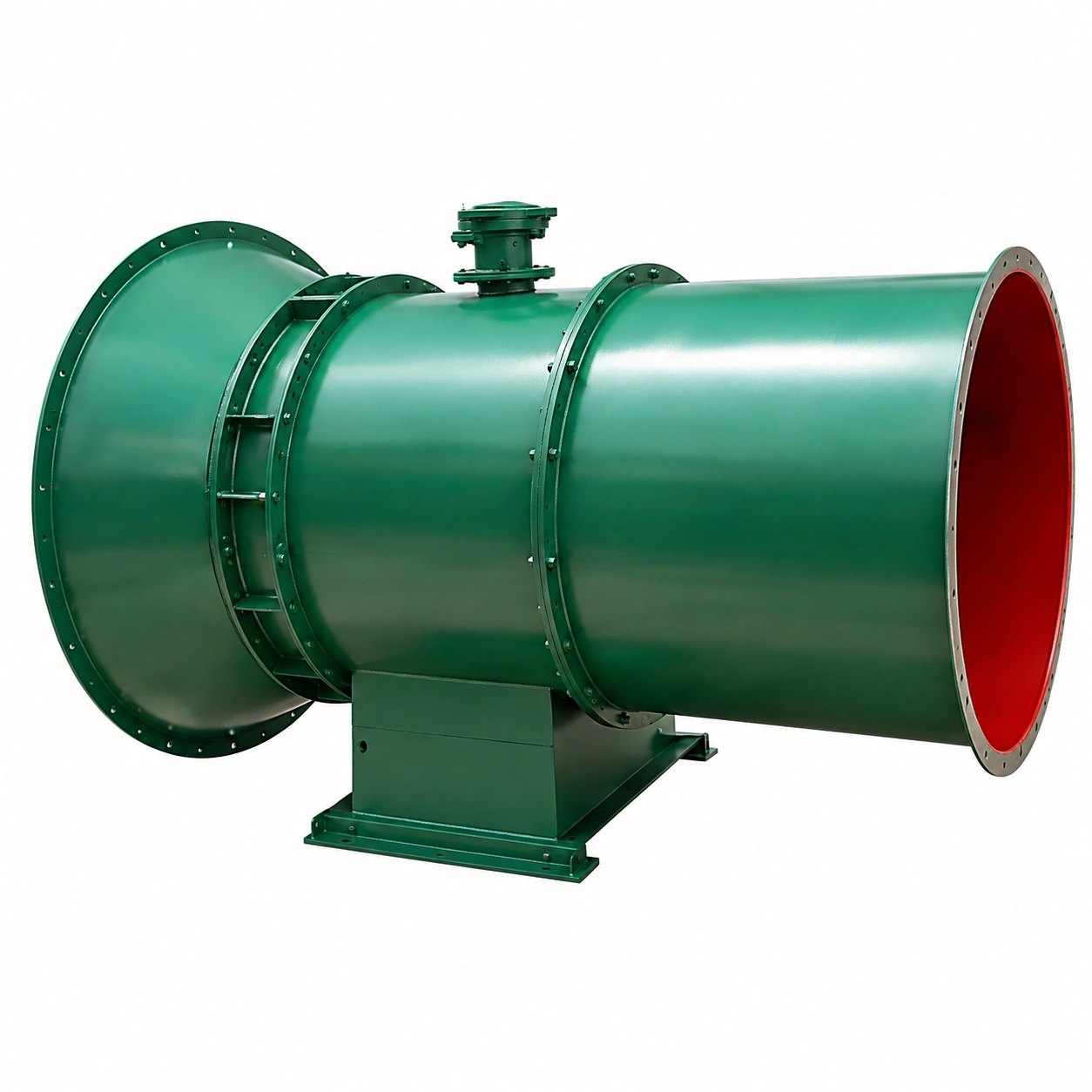


Press-In and Extractive Mine Ventilation Systems
Press-in and extractive ventilation describe the airflow arrangement in the mine or tunnel system. The appropriate method depends on contaminant control, duct layout, roadway geometry and project requirements.
Press-In Ventilation
Fresh air is delivered through ducting toward the heading or working face. Fan pressure must account for duct length, duct diameter, fittings, leakage and system resistance.
Extractive Ventilation
Contaminated air is drawn into the duct and discharged away from the working area. Fan position, duct airtightness and resistance should be reviewed as one system.
A Larger Fan Does Not Automatically Solve Low Airflow
Actual airflow at the working face depends on the complete ventilation system. Fan duty and duct condition should be reviewed together before increasing fan size or motor power.
How to Start Mine Ventilation Fan Selection
The fastest route to a useful fan recommendation is to define the project duty before comparing individual models.
Which Mine or Tunnel Fan Direction Fits the Project
| Ventilation Duty | Typical Position | Product Direction | Key Selection Focus |
|---|---|---|---|
| Mine Main Ventilation | Primary mine airflow network | FBCZ / FBCDZ / K-DK / FKZ-FKCDZ | Network airflow, resistance, installation and safety configuration |
| Local / Heading Ventilation | Roadway or working face | FB / FBD / FBCD / JK-DJK | Duct resistance, ventilation distance and press-in / extractive arrangement |
| Tunnel Construction | Excavation heading | SDF | Long-distance duct airflow, pressure loss and tunnel progress |
| Operating Road Tunnel | Tunnel crown / longitudinal airflow route | SDS | Jet thrust direction, tunnel layout and ventilation / smoke-control design |
| Working-Face Dust Control | Local underground work area | KCS | Dust concentration, local extraction and wet dust-control arrangement |
Replacing an Existing Mine Ventilation Fan?
Mine fan replacement should be treated as an engineering review rather than a direct model-name substitution. Existing fan data, installation interfaces and duct conditions should be checked before confirming a replacement direction.
Send Existing Fan DataInformation Needed for Mine Fan Selection
Providing the following data helps narrow the fan family and identify questions that must be confirmed before quotation.
Mine & Tunnel Ventilation Fan Questions
How do I choose between a main fan and a local ventilation fan?
Main fans serve the primary mine airflow network. Local fans normally connect to ducts and provide ventilation to headings, roadways or working faces.
What data is required to select a local mine ventilation fan?
Provide required airflow and pressure, duct diameter and length, leakage condition, ventilation distance, installation position, power supply and mine environment.
Can a larger fan solve insufficient airflow at the working face?
Not necessarily. Duct leakage, kinks, long duct runs, small duct diameter and system resistance can limit delivered airflow even when fan capacity is increased.
What is the difference between tunnel construction fans and jet fans?
Construction fans typically deliver air through ducts to the excavation face. Jet fans are generally used for longitudinal ventilation in completed road tunnels.
Can QIYUE FAN review an existing mine fan for replacement?
Yes. Send the original fan nameplate, drawing, airflow and pressure data, installation interfaces, electrical information and duct condition for engineering review.
Are explosion-proof and project-document requirements the same for every mine fan?
No. The required motor protection, safety configuration and documentation depend on the selected fan, mine environment, destination country and project specification.
Continue from Fan Family to Ventilation System Review
-
![FBC Extractive Mine Local Ventilation Fan]() FBC Extractive Mine Local Ventilation FanFBC Extractive Mine Local Ventilation Fan is designed for negative-pressure local exhaust ventilation in underground mine workings.read more
FBC Extractive Mine Local Ventilation FanFBC Extractive Mine Local Ventilation Fan is designed for negative-pressure local exhaust ventilation in underground mine workings.read more
It uses a single-stage axial configuration to extract... -
![FK / FKD Metal Mine Local Ventilation Fans]() FK / FKD Metal Mine Local Ventilation FansFK / FKD Metal Mine Local Ventilation Fans are designed for localized forced ventilation in metal mines and other non-coal underground mining applications.read more
FK / FKD Metal Mine Local Ventilation FansFK / FKD Metal Mine Local Ventilation Fans are designed for localized forced ventilation in metal mines and other non-coal underground mining applications.read more
FK covers conventional... -
![Tunnel Ventilation Fans]() Tunnel Ventilation FansProduct Short Description: Tunnel ventilation fan solutions for construction-stage duct air supply and completed road tunnel jet ventilation projects.read more
Tunnel Ventilation FansProduct Short Description: Tunnel ventilation fan solutions for construction-stage duct air supply and completed road tunnel jet ventilation projects.read more -
![Metal & Non-Coal Mine Ventilation Fans]() Metal & Non-Coal Mine Ventilation FansMine ventilation fan solutions for metal mines, non-ferrous mines, gold mines, building material mines and underground engineering projects, covering main ventilation, auxiliary ventilation and...read more
Metal & Non-Coal Mine Ventilation FansMine ventilation fan solutions for metal mines, non-ferrous mines, gold mines, building material mines and underground engineering projects, covering main ventilation, auxiliary ventilation and...read more -
![Coal Mine Ventilation Fans]() Coal Mine Ventilation FansCoal mine ventilation fan solutions for underground main ventilation, local face ventilation, roadway air supply and auxiliary ventilation projects.read more
Coal Mine Ventilation FansCoal mine ventilation fan solutions for underground main ventilation, local face ventilation, roadway air supply and auxiliary ventilation projects.read more -
![FB Explosion-Proof Press-In Mine Local Ventilation Fan]() FB Explosion-Proof Press-In Mine Local Ventilation FanFB Explosion-Proof Press-In Mine Local Ventilation Fan is designed for local air supply in coal mine roadways, tunneling faces and underground working areas. It provides press-in ventilation for...read more
FB Explosion-Proof Press-In Mine Local Ventilation FanFB Explosion-Proof Press-In Mine Local Ventilation Fan is designed for local air supply in coal mine roadways, tunneling faces and underground working areas. It provides press-in ventilation for...read more -
![FBCDZ Series Explosion-Proof Extractive Counter-Rotating Axial Flow Main Ventilation Fan]() FBCDZ Series Explosion-Proof Extractive Counter-Rotating ...FBCDZ Series Explosion-Proof Counter-Rotating Mine Main Ventilation Fan is designed for main ventilation systems in large coal mines. It adopts a counter-rotating axial flow structure, direct...read more
FBCDZ Series Explosion-Proof Extractive Counter-Rotating ...FBCDZ Series Explosion-Proof Counter-Rotating Mine Main Ventilation Fan is designed for main ventilation systems in large coal mines. It adopts a counter-rotating axial flow structure, direct...read more -
![FBCZ Series Explosion-Proof Extractive Axial Flow Main Ventilation Fan]() FBCZ Series Explosion-Proof Extractive Axial Flow Main Ve...FBCZ Series Explosion-Proof Extractive Axial Flow Main Ventilation Fan is designed for main ventilation systems in small and medium-sized coal mines. It features direct motor-impeller connection,...read more
FBCZ Series Explosion-Proof Extractive Axial Flow Main Ve...FBCZ Series Explosion-Proof Extractive Axial Flow Main Ventilation Fan is designed for main ventilation systems in small and medium-sized coal mines. It features direct motor-impeller connection,...read more -
![JK / DJK Series Mine Local Ventilation Fan]() JK / DJK Series Mine Local Ventilation FanJK / DJK Series Mine Local Ventilation Fan is designed for mine roadway excavation, stope ventilation, power scraper roadway air supply, tunnel construction and underground engineering projects...read more
JK / DJK Series Mine Local Ventilation FanJK / DJK Series Mine Local Ventilation Fan is designed for mine roadway excavation, stope ventilation, power scraper roadway air supply, tunnel construction and underground engineering projects...read more -
![FBD Series Explosion-Proof Press-In Counter-Rotating Local Ventilation Fan]() FBD Series Explosion-Proof Press-In Counter-Rotating Loca...FBD Series Explosion-Proof Press-In Counter-Rotating Local Ventilation Fan is designed for underground coal mine heading faces, mining roadways, chambers and tunnel ventilation projects. It is...read more
FBD Series Explosion-Proof Press-In Counter-Rotating Loca...FBD Series Explosion-Proof Press-In Counter-Rotating Local Ventilation Fan is designed for underground coal mine heading faces, mining roadways, chambers and tunnel ventilation projects. It is...read more -
![FBCD Series Explosion-Proof Extractive Counter-Rotating Local Ventilation Fan]() FBCD Series Explosion-Proof Extractive Counter-Rotating L...FBCD Series Explosion-Proof Extractive Counter-Rotating Local Ventilation Fan is designed for underground coal mine heading ventilation, return air roadways and gas-bearing excavation...read more
FBCD Series Explosion-Proof Extractive Counter-Rotating L...FBCD Series Explosion-Proof Extractive Counter-Rotating Local Ventilation Fan is designed for underground coal mine heading ventilation, return air roadways and gas-bearing excavation...read more -
![KCS Series Mine Wet Dust Collector Fan]() KCS Series Mine Wet Dust Collector FanKCS Series Mine Wet Dust Collector Fan is designed for dust control at coal mine heading faces, tunneling faces and underground excavation workplaces. It combines air extraction, wet spray dust...read more
KCS Series Mine Wet Dust Collector FanKCS Series Mine Wet Dust Collector Fan is designed for dust control at coal mine heading faces, tunneling faces and underground excavation workplaces. It combines air extraction, wet spray dust...read more


With abundant experience, we are one of the most reliable mine & tunnel ventilation fans manufacturers and suppliers in China. Please feel free to wholesale high quality mine & tunnel ventilation fans made in China here from our factory. We also accept customized orders.
Send Inquiry