01 / Engineering Overview
Local Duct Ventilation for Underground Roadways and Working Areas
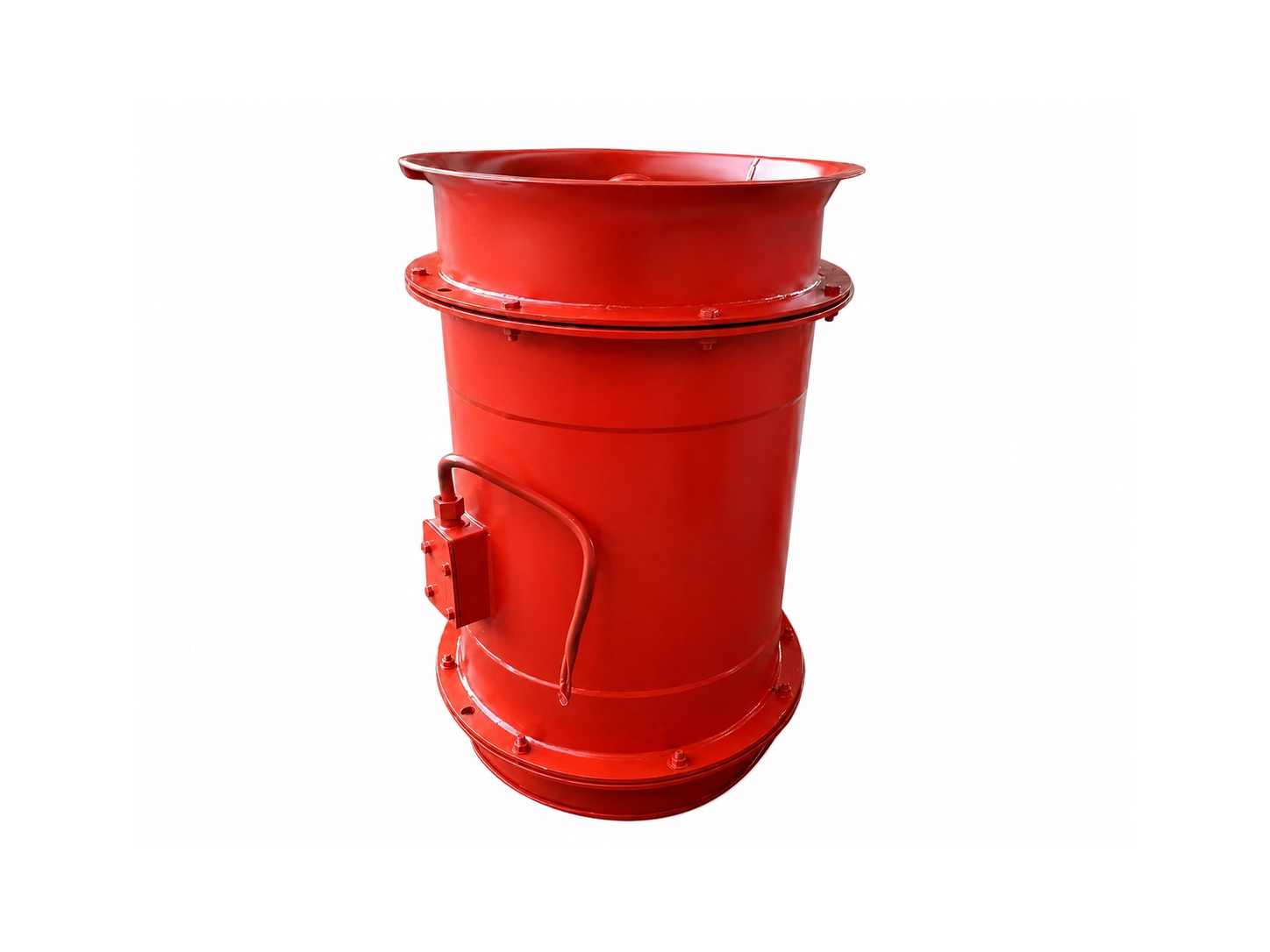
JK / DJK series is designed for local ventilation rather than the primary mine ventilation network. The fan delivers air through ventilation ducting to a defined underground working area such as a roadway heading, stope access or construction face.
Because excavation conditions and duct lengths change as work progresses, the series focuses on practical local air supply, compact arrangement and the ability to match different duct-system resistance levels.
01 / LOCAL AIR SUPPLY
Deliver Air to the Working Zone
The fan works with ventilation ducting to supply air to roadways, faces and underground work sections.
02 / DUCT RESISTANCE
Pressure Must Match the Duct
Longer air-delivery distance and higher duct resistance require greater pressure capability.
03 / MOBILITY
Adapt to Excavation Progress
The compact local-fan concept is suitable where the fan position or duct arrangement changes as underground work advances.
02 / Series Structure
JK Single-Stage or DJK Counter-Rotating?
The two configurations serve the same general local-ventilation role but cover different duct-resistance and pressure requirements.
JK SERIES
Single-Stage Local Ventilation
JK models are used for conventional local duct ventilation where the required airflow and pressure can be achieved with a single-stage fan configuration.
Typical review points
Duct diameter
Ventilation distance
Required airflow
Pressure loss
DJK SERIES
Counter-Rotating for Higher Resistance
DJK uses a counter-rotating configuration and should be reviewed when the duct system requires higher pressure capability or has greater ventilation resistance.
Typical review points
Longer duct route
Higher pressure loss
Higher system resistance
Required face airflow
Noise requirement: the series is positioned as a low-noise local ventilation direction, and a silencer can be considered when the project has additional underground noise-control requirements.
03 / Typical Working Areas
Local Ventilation for Roadways, Stopes and Underground Construction
01 / ROADWAY
Mine Roadway Excavation
Local duct air supply for advancing mine roadways and underground working sections where fresh air has to be delivered directly to the work area.
02 / STOPE
Stope Air Guidance
Suitable for stope ventilation and power scraper roadway air induction where local airflow support is required.
03 / SUBLEVEL
Sublevel Mining Access
Can be used for access-roadway ventilation in sublevel mining and other auxiliary underground air-supply positions.
04 / TUNNEL
Tunnel Construction
Applicable to tunnel and underground engineering projects where local air supply is delivered through ventilation ducting.
04 / Duct & Ventilation Distance
Duct Diameter and Air-Delivery Distance Determine the Pressure Requirement
For local mine ventilation, fan performance and the ventilation duct have to be treated as one system. The same airflow requirement can need very different fan pressure when the duct diameter or delivery distance changes.
SELECTION ITEM
AVAILABLE INFORMATION
SELECTION MEANING
Duct Diameter
300–800 mm in the listed representative range
Fan size should match duct size and the required airflow.
Air Delivery
80–600 m according to model
Longer ventilation distance normally increases the pressure requirement.
Fan Structure
JK single-stage / DJK counter-rotating
DJK should be reviewed where higher pressure or greater duct resistance is involved.
Noise Control
Low-noise direction; silencer optional
A silencer can be considered where the project has additional noise requirements.
Shorter Duct Run
A conventional JK operating point may be sufficient when the required airflow can be delivered through a lower-resistance duct system.
Longer Duct Run
As duct length and resistance increase, a higher-pressure JK model or DJK counter-rotating configuration may need to be reviewed.
06 / Performance Guide
How to Read JK / DJK Performance Data
A local ventilation fan should not be selected from motor power alone. The duct system and the amount of air that must reach the working area are equally important.
01
Airflow
The volume of air provided by the fan within the listed operating range.
02
Pressure
The pressure capability available to overcome resistance in the ventilation duct system.
03
Duct Diameter
The listed duct size direction should be checked against the project ventilation duct.
04
Delivery Distance
Shows the reference local air-delivery distance for the listed model.
05
Power
Motor power follows the selected fan configuration and operating requirement.
06
Overall Size
Use the listed external dimensions to check available underground installation and connection space.
07 / Selection Logic
What to Send for JK / DJK Local Fan Selection
The most useful starting point is the actual duct ventilation requirement. If pressure is not yet known, provide the duct diameter, route and ventilation distance together with the required airflow.
01
Application Area
Mine roadway, stope, sublevel access, tunnel construction or other underground local ventilation duty.
02
Duct Diameter
Provide the actual or planned ventilation-duct diameter.
03
Air Delivery Distance
Provide the total distance from the fan position to the working area.
04
Required Airflow
State the required airflow at the local working section.
05
Required Pressure
Provide calculated pressure if available, or provide the duct information for preliminary review.
06
Noise Requirement
State whether additional noise-control measures or a silencer need to be reviewed.
07
Quantity
Provide the required number of fans and the number of working sections to be ventilated.
08 / Product Boundary
JK / DJK Is Not the Same Selection Direction as FBD or FBCD
Several local mine fan families may look similar, but their intended ventilation role and project conditions are different. Confirm the ventilation method before selecting by model.
PRODUCT
MAIN DIRECTION
WHEN TO REVIEW
JK / DJK
General mine and underground local duct ventilation
Roadway, stope, underground engineering and tunnel local air supply
FBD
Explosion-proof press-in local ventilation
Coal-mine projects requiring press-in local ventilation and project-specific explosion-proof configuration
FBCD
Extractive local ventilation
Negative-pressure duct systems and extractive underground ventilation duties
09 / FAQ
JK / DJK Mine Local Ventilation Fan Questions
What is the difference between JK and DJK?
JK is the single-stage local ventilation direction. DJK uses a counter-rotating configuration and is considered where higher pressure or greater duct resistance is involved.
Is JK / DJK a mine main ventilation fan?
No. The JK / DJK series is intended for local and auxiliary underground ventilation where air is delivered to a specific working zone through ducting.
How far can JK / DJK deliver air?
The current page information shows reference air-delivery distances from 80 m to 600 m depending on the model. Actual performance must still be checked against the duct system.
Does a longer ventilation distance always require a larger fan?
Not necessarily. Duct diameter, airflow requirement and pressure loss must be reviewed together. The correct solution may involve a different pressure configuration rather than simply a larger fan.
Can a silencer be supplied?
The current product information states that a silencer can be considered when the project has special underground noise-control requirements.
Should I choose FBD instead for a coal mine project?
If the project specifically requires coal-mine explosion-proof press-in local ventilation, the FBD series should be reviewed separately against the required mine-safety configuration.
When should FBCD be reviewed instead?
FBCD is a different direction intended for extractive local ventilation using negative-pressure ducting.
What information is needed before quotation?
Provide application area, duct diameter, air-delivery distance, required airflow, required pressure, noise requirement and quantity.