


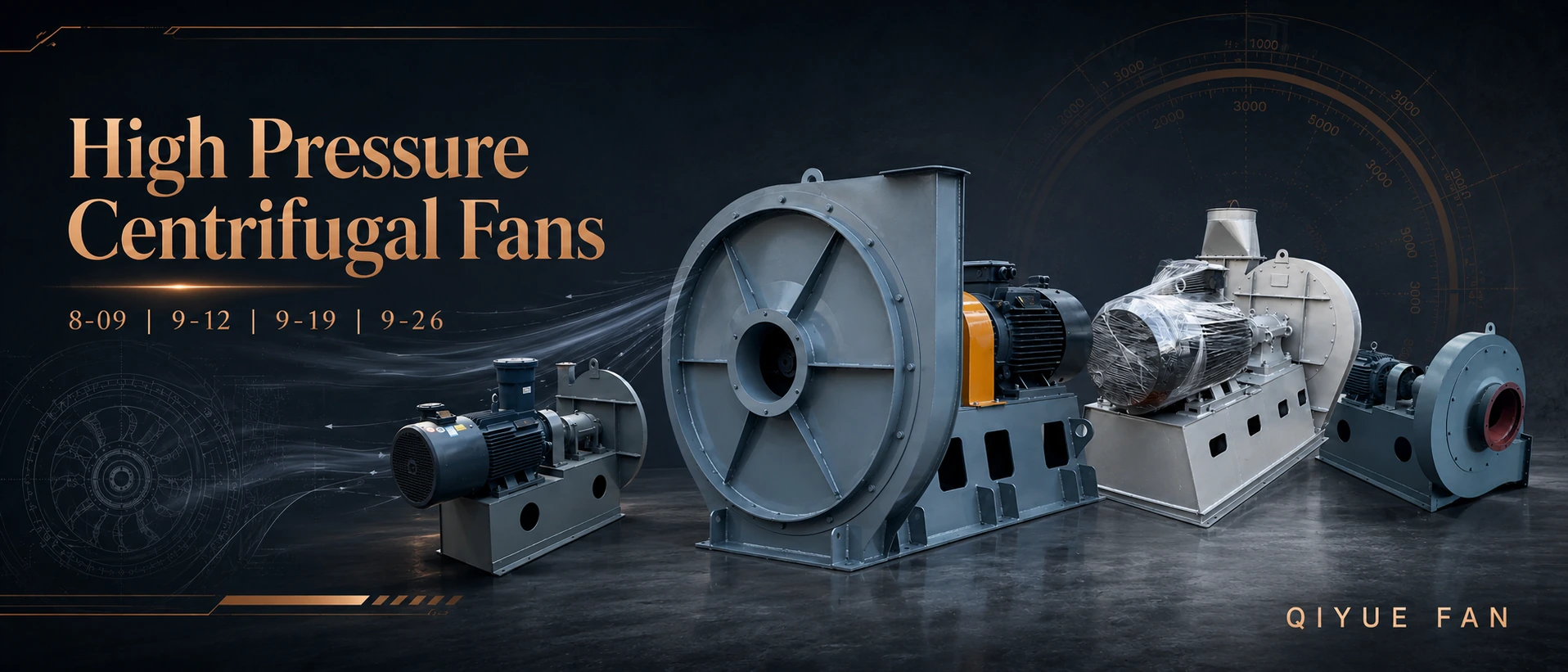
This is a selection entrance, not a duplicate of one model page
High pressure centrifugal fan projects often begin with an old model name, a motor power, or a rough application. That is not enough for accurate selection. This series page gives a first-round comparison path before buyers enter the 8-09, 9-12, 9-19, 9-26 or 10-16 product pages.
Same name, different working point
A fan series name only gives a direction. The actual fan number, speed, motor power, drive arrangement and outlet direction still depend on the operating point.
Power cannot replace pressure data
Two fans with similar motor power may have different airflow and pressure. Motor power should be checked after airflow, pressure and efficiency are reviewed.
The same application may need different series
Dust collection, furnace air supply or pneumatic conveying can point to different fan directions when resistance, dust load, airflow volume and layout change.
Start from the source of pressure loss
The first selection question is not "which model is best?" but "where does the system resistance come from?" The answer decides which QIYUE FAN high pressure centrifugal fan direction should be reviewed first, including whether 10-16 should be checked as an additional series.
| First Question | Typical Resistance Source | First Series Direction | What QIYUE FAN Must Confirm | Next Step |
|---|---|---|---|---|
| Is the main duty furnace air supply? | Furnace body, air path, burner or process chamber resistance | Review 8-09 first | Airflow, total pressure, gas temperature, particle content, outlet angle and rotation direction. | Send furnace duty and working point. |
| Is the main issue long duct or process equipment loss? | Long pipelines, elbows, dampers, equipment chambers or auxiliary resistance | Review 9-12 first | Duct route, diameter, pressure loss points, required airflow, medium and installation space. | Provide duct sketch or equipment resistance. |
| Is the system a pressure-first forced air application? | Boiler forced draft, combustion support, equipment air supply or process airflow | Review 9-19 first | Total pressure, airflow, drive arrangement, motor voltage, operation time and site layout. | Check whether A type or D type direction is more suitable. |
| Is the project based on a 10-16 specification or a high-pressure air-supply duty that needs separate verification? | Furnace, boiler, process equipment, duct network or another high-pressure industrial air-supply system | Review 10-16 as an additional direction | Required airflow, total pressure, fan number, speed, drive arrangement, medium temperature and site layout. | Compare the working point with 9-19 and 9-26 before final confirmation. |
| Does the project need larger airflow plus high resistance? | Large dust collection line, conveying air source, heavy-duty industrial airflow or large process system | Review 9-26 first | Air volume, resistance loss, dust load, material type, bearing arrangement, foundation and electrical capacity. | Compare with 9-19 if the duty point is not heavy enough. |
Which high pressure fan series should be reviewed first?
The cards below do not replace the individual product pages. They define the first selection direction and show when 10-16 should be added to the comparison so buyers can enter the most relevant model page with clearer project data.
Do not force the project into only one model direction too early
Some projects sit between two series directions. QIYUE FAN may compare two options before confirming the final fan number, speed, motor power and drive arrangement.
Pressure-first system or heavier large-volume system?
When dust collector resistance, conveying demand or larger airflow is involved, 9-19 and 9-26 may both be checked. The deciding data is not the application name, but airflow volume, pressure point, dust load, motor load and site foundation.
Furnace duty or route resistance?
If the request mentions furnace air supply but the real challenge is long duct loss or equipment pressure drop, QIYUE FAN may review whether 8-09 or 9-12 is the better first direction.
Existing specification or pressure-first forced-air direction?
When a project names 10-16 but the required duty also overlaps a pressure-first industrial air-supply application, QIYUE FAN should compare the actual airflow, total pressure, speed, drive arrangement and medium condition before confirming the series.
Old fan nameplate is useful, but not enough
For fan replacement, nameplate photos, old drawings, current motor power and site photos help. However, airflow, pressure and actual process conditions should still be reviewed before confirming an equivalent fan.
Send data by project type before asking for a model
A clear inquiry allows QIYUE FAN to compare high pressure fan series faster and avoid wrong direction caused by incomplete information.
Furnace or boiler air supply
Send furnace type, air volume, total pressure, gas temperature, working hours, outlet direction, voltage and site layout.
Dust collector or filter system
Send dust type, filter resistance, duct layout, collection point number, required suction, temperature and fan position.
Pneumatic conveying or process air
Send material type, conveying distance, pipeline size, air volume, pressure demand, dust load and whether material passes through the fan.
Replacement of existing fan
Send nameplate, old model, motor data, rotation direction, outlet angle, photos, drawing and current problem on site.
Continue the selection path with technical guides
High pressure fan selection is closely connected with pressure calculation, dust collector resistance, material choice, rotation direction and outlet angle. These guides help buyers prepare a more complete inquiry.
Questions before choosing a high pressure fan series
These questions focus on first-round direction judgment, not the detailed parameters of one specific model.
Which high pressure fan series should I review first?
Start from the resistance source. Furnace air supply may start from 8-09, long duct or equipment resistance may start from 9-12, pressure-first forced air systems may start from 9-19, and larger airflow with heavy resistance may start from 9-26. Review 10-16 as an additional direction when the project specifies this series or when its working point needs comparison with 9-19 or 9-26.
When should 9-19 and 9-26 be compared together?
They may both be reviewed when the project involves high resistance and medium-to-large airflow, such as larger dust collection, conveying air source or process airflow systems. The final direction depends on airflow, pressure, dust load, motor load and site conditions.
When should the 10-16 high pressure centrifugal fan be reviewed?
Review 10-16 when it is named in the project specification or when the required airflow and total pressure indicate that this series should be compared with other high-pressure directions. Final selection still requires speed, drive arrangement, medium condition, installation layout and motor data.
Why is motor power not enough for high pressure fan selection?
Motor power is a result of airflow, pressure, speed and efficiency. If only motor power is known, the selected fan may not reach the required pressure or airflow.
Can I replace an old fan only by model name?
Model name is helpful, but QIYUE FAN still needs nameplate photos, airflow, pressure, motor data, rotation direction, outlet angle, site photos or drawings to confirm an equivalent or improved replacement.
What should I send before QIYUE FAN recommends a series?
Please send application duty, airflow, total pressure or system resistance, gas temperature, dust condition, duct layout, voltage, frequency, installation direction and any available drawing or old fan information.
Hot Tags: high pressure centrifugal fans, China high pressure centrifugal fans manufacturers, suppliers, factory


