

QIYUE FAN · APPLICATION SELECTION GUIDE
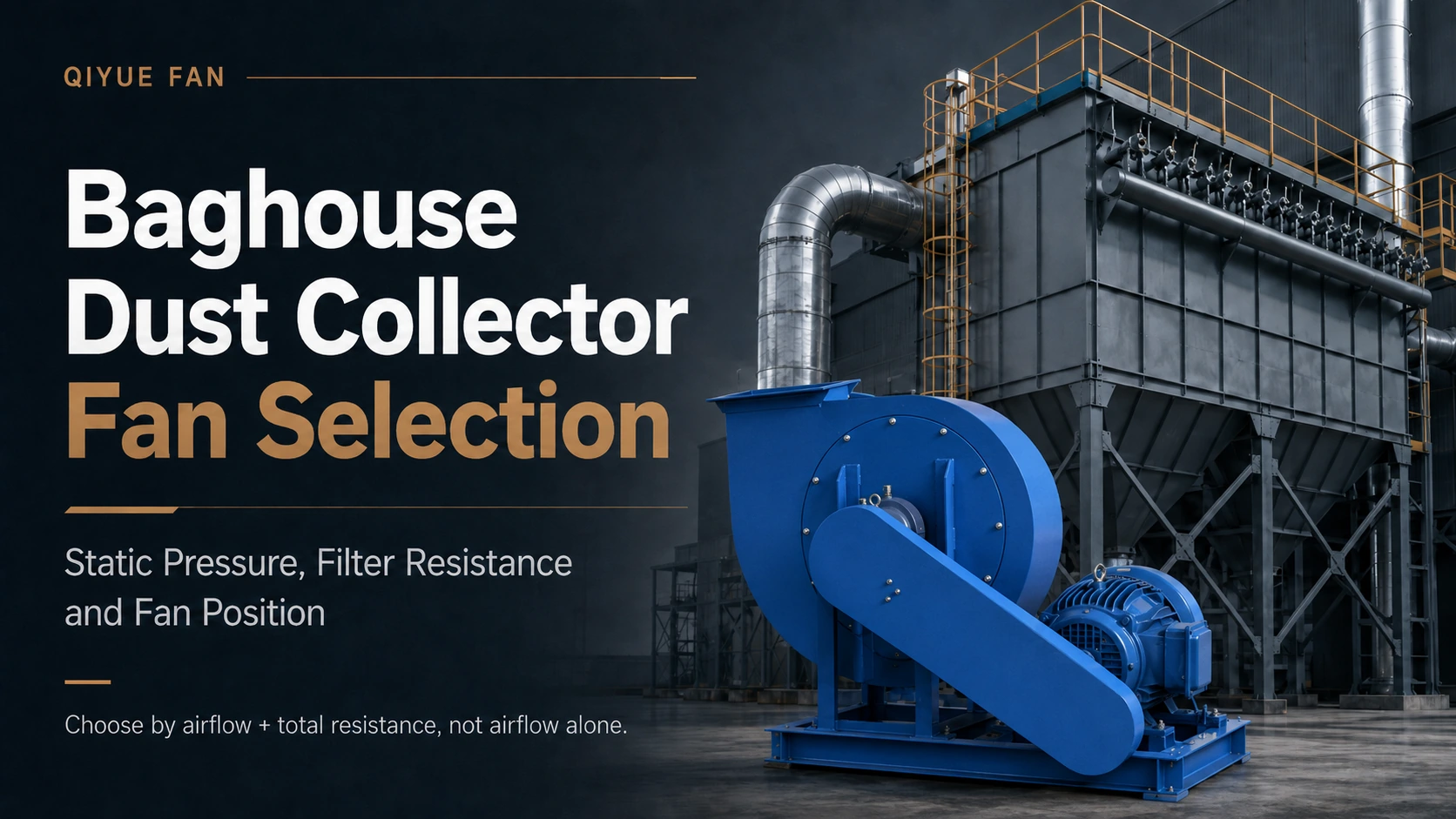
Baghouse Dust Collector Fan Selection
Selecting a fan for a baghouse dust collector is not only about airflow. The fan must overcome duct resistance, baghouse filter resistance, loaded-filter pressure drop and outlet loss while maintaining stable capture airflow in real operating conditions.
Selection focus: airflow, static pressure, total pressure, filter resistance, loaded-filter pressure drop, dust type, particle size, fan position, duct layout, outlet angle and motor standard.
Baghouse Resistance Route
01 · Capture Hood
Capture airflow
02 · Duct Network
Friction + elbows + branches
03 · Baghouse Filter
Filter resistance + loaded-filter drop
04 · System Fan
Final static-pressure review
Select for loaded-filter condition, not only clean-filter startup.
In This Guide
Selection Principle
Why Baghouse Fan Selection Must Start from System Resistance
In a baghouse dust collector system, the fan creates the airflow that pulls dust-laden air from capture points, through ducts and into the filter collector. If fan pressure is too low, capture velocity drops, dust escapes from the source, and the system cannot maintain stable exhaust performance.
The most common selection error is using only clean-filter resistance. As filter bags load with dust, the pressure drop increases. A practical baghouse fan selection should consider clean-filter condition, loaded-filter pressure drop, duct friction, elbows, dampers and final outlet loss. Calculate the required system airflow before confirming fan pressure →
01 · Airflow
Capture All Active Hoods
Total airflow must cover all capture hoods and simultaneous-use conditions.
Airflow Calculation →02 · Static Pressure
Complete Resistance Network
Include duct resistance, filter resistance, loaded-filter drop and outlet loss.
03 · Dust Condition
Wear and Handling Risk
Dust type, particle size, hardness and concentration affect fan position and wear risk.
04 · Fan Position
Clean Side or Dust Side
Clean-side and dirty-side arrangements have different wear and leakage characteristics.
Pressure Review
What Should Be Included in Baghouse Fan Pressure?
For most baghouse systems, filter resistance is one of the dominant pressure losses. The fan should be checked against the complete resistance network, not against clean-filter data alone.
| Resistance Item | What It Means | Why It Matters |
|---|---|---|
| Capture hood loss | Pressure loss around hood or enclosure | Affects dust capture at the source |
| Duct resistance | Friction loss from duct length and diameter | Long ducts can significantly reduce airflow |
| Elbows and dampers | Local loss from turns, valves and branches | Complex layouts increase static-pressure demand |
| Baghouse filter resistance | Pressure drop through filter bags | Often the main resistance in a baghouse system |
| Loaded-filter pressure drop | Resistance after dust accumulates on filter bags | Prevents airflow shortage after operation |
| Stack or outlet loss | Loss at discharge stack or final outlet | Should be included before final motor review |
Practical rule: Required fan pressure = hood loss + duct friction + branch and elbow loss + baghouse filter resistance + loaded-filter pressure drop + outlet loss + project margin.
Pressure Basis
Static Pressure vs Total Pressure
Confirm whether the project and fan curve use the same pressure definition.
Pressure Unknown
Static Pressure Unknown
Use duct, filter and resistance information when no final pressure value is available.
Operating Point
Fan Performance Curve
Check airflow and pressure together at the actual working point.
Fan Position
Clean-Side Fan or Dust-Laden Side Fan?
The fan may be installed before or after the baghouse, depending on system design. The correct arrangement should be reviewed by dust characteristics, wear risk, leakage direction and maintenance requirements.
Clean Side
Clean-Side Fan After Baghouse
The fan is installed after the baghouse filter, so cleaner air passes through the impeller. This arrangement usually reduces fan wear when filtration is effective.
• Lower particle exposure to the impeller
• Fan pressure must include full baghouse resistance
• Check residual dust and filter leakage condition
Dust Side
Dust-Laden Side Fan Before Baghouse
The fan handles dust-laden air before final filtration. This arrangement requires careful review of dust type, particle size, particle hardness, concentration and buildup risk.
• Fan directly contacts contaminated airflow
• Abrasive particles may increase impeller wear
• Pre-separation should be reviewed where possible
Abrasive dust note: Cement, mineral and grinding dust may require pre-separation and wear-protection review. Review cement and mineral dust applications →
Selection Path
How to Select a Baghouse Dust Collector Fan
Selection should be based on airflow and pressure at the same operating point. Motor power is confirmed after fan model, speed, efficiency and safety margin are reviewed. See Industrial Fan Power Calculation.
Fan Model Direction
Which QIYUE FAN Direction Can Be Reviewed?
Final fan selection depends on airflow, static pressure or total pressure, dust condition, fan position and motor standard. The following directions help buyers understand the preliminary review path.
Light Dust
C6-48 Dust Collection Fan
Can be reviewed for light dust, wood chips, fine fibers and similar loose particles after checking particle size and duct resistance.
View C6-48 Product →Higher Resistance
9-19 / 9-26 High Pressure Fan
May be reviewed for higher-resistance systems, long ducts, multiple elbows or operating points requiring higher static pressure.
View High Pressure Fan →Clean Side
General Centrifugal Fan Direction
A general centrifugal fan direction may only be reviewed when the air is suitably filtered and the remaining dust level is acceptable.
View Centrifugal Fans →Quotation Data
Information Needed Before Quotation
Complete project information helps QIYUE FAN review the suitable fan series, pressure, motor power, drive arrangement, outlet direction and installation configuration.
System & Dust Data
Performance and Medium
• Required airflow
• Static pressure or total pressure
• Baghouse type and filter resistance
• Loaded-filter pressure drop
• Dust type, concentration and particle size
• Temperature, moisture and stickiness
Installation & Motor Data
Installation and Electrical
• Duct length, diameter, elbows and branches
• Fan position before or after baghouse
• Outlet angle and rotation direction
• Motor voltage, frequency and phase
• Installation space and base requirements
• Quantity and destination country
Technical Next Steps
Continue Through the Dust Collection Selection Route
Use the next guide according to whether the open question is airflow, pressure, operating point, power or the complete application system.
Application Hub
Industrial Dust Collection System →
Review the full route from dust source and capture hood to ductwork, collector, fan and clean-air discharge.
Airflow
Dust Collection System Airflow Calculation
Calculate hood airflow, simultaneous-use points and preliminary total system airflow.
Pressure
Static Pressure vs Total Pressure
Confirm the correct pressure definition before fixing the fan duty point.
Operating Point
Fan Performance Curve
Check airflow and pressure together at the real system working point.
Motor Power
Industrial Fan Power Calculation
Confirm motor kW after duty point, efficiency and safety margin are established.
Abrasive Dust
Cement Plant Dust Collection Fans
Review mineral-particle abrasion, pre-separation and wear-protection requirements.
Baghouse Fan FAQ
FAQ About Baghouse Dust Collector Fan Selection
Should baghouse fan pressure include filter resistance?
Yes. For a baghouse dust collector system, static pressure or total pressure should include duct loss, elbows, dampers, baghouse filter resistance, loaded-filter pressure drop and outlet loss. Clean-filter resistance alone may cause insufficient airflow after operation.
Is the fan installed before or after the baghouse?
Both arrangements are possible. A clean-side fan is installed after filtration and normally faces less impeller wear. A dust-laden side fan must be reviewed according to dust type, particle size, particle hardness, concentration and buildup risk.
Can C6-48 be used for a baghouse dust collector?
C6-48 can be reviewed for light dust, wood chips, fine fibers and similar loose particles. If the baghouse system has high static pressure, long ducts, heavy abrasive dust or high filter resistance, QIYUE FAN may review 9-19 or 9-26 high-pressure fan directions.
Why does airflow drop after the dust collector runs for some time?
A common reason is that loaded-filter pressure drop was not included during fan selection. As dust builds on filter bags, resistance increases and the actual airflow may fall below the required capture airflow.
Should I select the fan only by motor power?
No. Motor power does not define the operating point. The fan should first be checked by airflow and static pressure or total pressure. Motor power is confirmed after fan speed, efficiency, working point and safety margin are reviewed.
What data should be provided for quotation?
Please send airflow, static pressure or total pressure, baghouse type, filter resistance, loaded-filter pressure drop, dust type, particle size, duct length, elbows, fan position, temperature, outlet angle, rotation direction, voltage and quantity.
How should airflow be calculated before selecting a baghouse fan?
Calculate airflow from each capture hood, hood opening or capture velocity, simultaneously active points, branch balance and a suitable allowance. Then confirm that duct conveying velocity remains adequate. Use the dust collection system airflow calculation guide before fixing the fan operating point.
What should be reviewed for cement and abrasive mineral dust?
Cement and mineral dust can accelerate impeller and casing wear. Review particle hardness, concentration, pre-separation efficiency, fan position, collector resistance and possible wear-resistant construction before selection. See the cement plant fan application guide.
Fan Selection Support
Need a Baghouse Dust Collector Fan Selection?
Send your airflow, static pressure, filter resistance, loaded-filter pressure drop, duct layout, dust type, particle size, fan position and motor voltage. QIYUE FAN can review the suitable centrifugal fan direction for your baghouse dust collection system.
Airflow · Static Pressure · Total Pressure · Filter Resistance · Loaded-Filter Pressure Drop · Dust Type · Particle Size · Duct Layout · Fan Position · Outlet Angle · Voltage · Quantity
Manager Zhao
Industrial Ventilation Fan Supplier
SHANDONG QIYUE FAN CO., LTD.
Tel / WeChat / WhatsApp: +86 15653305981
Email: sales@qiyuefan.com
Factory: Dongchen Industrial Park, Zhoucun District, Zibo, Shandong, China