


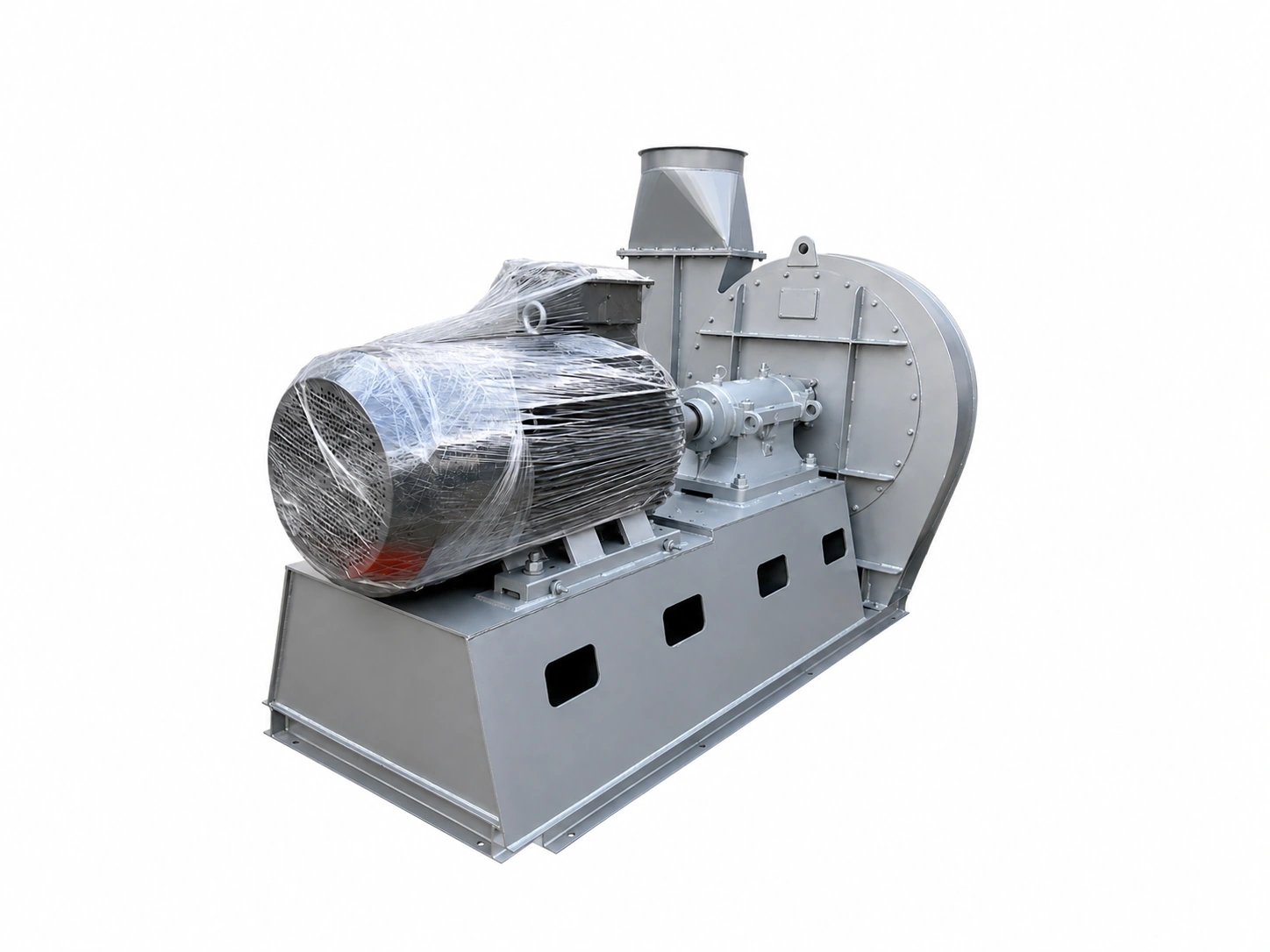
Larger-Duty Selection
Used when the project requires high pressure together with a larger airflow range than smaller high-pressure selections.
Heavy System Loss
Filter loss, separators, long duct routes, conveying lines and equipment resistance must be included.
Confirm Before Quote
Particle hardness, dust concentration and separation efficiency affect wear and fan-position decisions.
Foundation and Motor
Large-duty selections require review of motor load, bearing arrangement, foundation and maintenance space.
High Pressure Fan for Larger Airflow and Heavier Industrial Resistance
The 9-26 series is normally considered when the project requires pressure reserve and larger air volume. It can be reviewed for dust collection exhaust, industrial furnace air supply, material conveying support and heavy-duty equipment ventilation.
In many 9-26 projects, the fan works with filters, separators, long duct routes, conveying pipelines or high-resistance equipment. Dust concentration, filter pressure loss, conveying distance, motor load and bearing arrangement directly affect the final selection.
For dust collection systems, 9-26 should be reviewed from the system route and operating point. It should not be described as a universal direct dust fan for untreated abrasive particles.
Review 9-26 for Larger-Airflow Conveying Systems After the Duty Is Defined
For pneumatic conveying and bulk material handling, 9-26 may be reviewed when the system requires larger airflow or heavier resistance capacity. Confirm material characteristics, conveying rate, pipeline size, total pressure, route length, dust condition and fan position before selecting the final model.
Suitable Direction vs Separate Engineering Review
High Resistance System Support
Do Not Treat as Direct Abrasive-Dust Fan
Basic Product Information for Early Selection
9-26 for Larger-Duty High Pressure Work
9-19 is commonly reviewed for pressure-first selection in high-resistance systems. 9-26 is reviewed when larger airflow capacity, heavier motor load or heavier resistance duty is involved.
Compare 9-19 Fan →Data Required Before Quotation
Send airflow, total pressure, dust load, filter resistance, duct route, conveying distance, voltage, foundation condition, rotation and outlet angle.
Open Fan Selection Center →Typical Applications of 9-26 High Pressure Fans
Dust Collector Exhaust
High-resistance dust collection systems after collector and filter resistance are included.
Industrial Furnace Air
Heavy-duty forced airflow for furnace and process air systems.
Material Conveying
Conveying support after pressure loss, medium and duty cycle are reviewed.
Heavy Equipment Ventilation
Equipment airflow where larger motor load and higher resistance are involved.
Long Duct Systems
Long routes, elbows, filters or separators creating high total pressure demand.
Replacement Projects
Model comparison by old nameplate, motor load, duct route and measured duty point.
Continue from 9-26 to Dust Collection System Selection
Use these pages to decide whether 9-26 is suitable for collector exhaust, conveying support or another heavy-duty dust collection direction.
Dust Collection Fans
Compare C6-48, 9-19, 9-26 and other fan directions.
View Category →Industrial Dust Collection System
Review hoods, ducts, collectors, fan position and total resistance.
Review System →Airflow Calculation
Calculate capture airflow, active branches and preliminary fan demand.
Calculate Airflow →Baghouse Fan Selection
Include clean-filter and loaded-filter resistance in the operating point.
Review Baghouse →Cement Plant Fan Solutions
Review abrasive mineral dust, pre-separation and wear protection.
View Application →FAQ About the 9-26 High Pressure Centrifugal Fan
What is the 9-26 fan used for?
Dust collector exhaust, industrial furnace air supply, material conveying support, heavy equipment ventilation and high-resistance airflow systems.
How is it different from 9-19?
9-26 is reviewed when the project needs larger airflow capacity, heavier motor load or heavier resistance duty than typical 9-19 selections.
Can it handle dust collection?
Yes, but dust load, filter resistance, separation efficiency, particle hardness and fan position must be confirmed before selection.
What data should be sent?
Airflow, total pressure, system resistance, dust condition, medium temperature, voltage, outlet angle, rotation, foundation layout and quantity.
Send Your 9-26 Fan System Data
Share airflow, total pressure, dust load, system resistance, medium temperature, motor voltage, outlet direction, rotation, foundation layout and quantity. For pneumatic conveying, also include the material, conveying rate, pipeline size and route.
Hot Tags: 9-26 high pressure centrifugal fan, China 9-26 high pressure centrifugal fan manufacturers, suppliers, factory


