
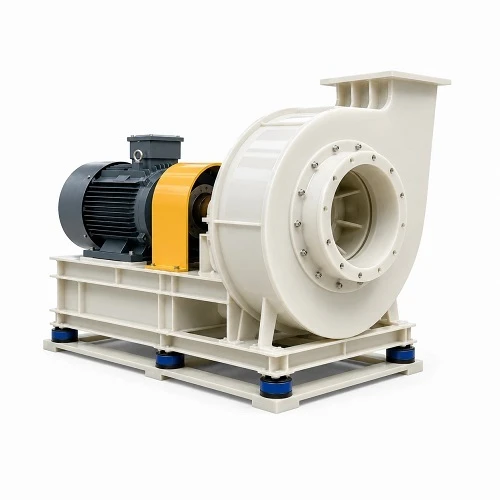
Heavy-duty mechanical ventilation unit engineered to extract toxic smoke, hot gases, and heat from commercial and industrial facilities during a fire emergency. Built to operate continuously under elevated temperatures (typically 250C to 400C for 2 hours) while maintaining structural integrity and required airflow pressure. Designed for integration into centralized Building Management Systems (BMS) and Life Safety Systems.
Key Features
High-Temperature Endurance: Operates continuously at 300C for a minimum of 120 minutes, certified to international fire-safety standards.
Class H Motor Isolation: Wound with high-temperature magnet wire and insulated with Class H materials, paired with external cooling air paths to prevent thermal breakdown.
Reinforced Steel Casing: Heavy-gauge carbon steel or stainless steel housing with stiffening ribs to resist thermal warping and structural collapse under negative pressure.
Precision-Balanced Impellers: Backward-curved centrifugal or aerofoil axial impellers dynamically balanced to ISO 1940 Grade G2.5 to minimize vibration and bearing wear at high rotational speeds.
Dual-Function Capability: Operates as standard daily ventilation equipment and switches automatically to emergency smoke extraction mode upon receiving a fire alarm signal.
Technical Specifications
|
Technical Parameter |
Standard Range / Specification |
|
Airflow Volume |
3,000 m3/h to 120,000 m3/h |
|
Static Pressure |
Up to 2,500 Pa |
|
Operating Temperature |
250C / 300C / 400C (Duration: 2 Hours) |
|
Impeller Material |
Q235B Carbon Steel, 304/316 Stainless Steel, Cast Aluminum |
|
Motor Power |
0.75 kW to 250 kW |
|
Power Supply |
380V/415V/460V, 50Hz/60Hz, 3-Phase |
|
Acoustic Level |
65 dB(A) to 85 dB(A) at 3 meters (optional silencing casing) |
|
Certifications |
ISO 9001, CE, AMCA 300/210 compliant testing, UL 705 applicable |
Construction & Working Principle
The unit consists of a rigid housing, high-temperature electric motor, drive assembly, and an aerodynamically profiled impeller.
During a fire emergency, the control panel overrides standard ventilation parameters. The high-torque motor drives the impeller at rated RPM to draw dense smoke and hot air away from escape routes and into dedicated vertical shafts or discharge ducts. The motor is isolated from the main airstream via a sealed cooling compartment or placed outside the duct stream (depending on configuration), ensuring uninterrupted operation while ambient temperatures inside the duct exceed normal thresholds. Casing joints are fully welded and sealed with high-temperature ceramic gaskets to prevent smoke leakage into adjacent unburned zones.
Applications
Commercial Complexes: Underground parking garages, shopping mall atriums, and multi-story stairwell pressurization systems.
Transport Infrastructure: Road tunnels, railway stations, and underground metro platforms.
Industrial Facilities: Chemical processing plants, heavy manufacturing workshops, and high-bay logistics warehouses.
Energy & Data Centers: Generator rooms, battery storage facilities, and server hall emergency exhaust paths.
Available Options
Drive Configurations: Direct drive (lower maintenance) or belt drive (flexible airflow adjustment via pulley swaps).
Casing Materials: Hot-dip galvanized steel, epoxy-coated carbon steel, or 316 stainless steel for corrosive chemical environments.
Accessory Package: Inlet/outlet dampers, flexible connectors, weather hoods, bird screens, vibration isolators, and weatherproof motor covers.
Control Integration: Variable Frequency Drive (VFD) compatibility for dual-speed daily ventilation and emergency smoke clearance.
Manufacturing & Quality Control
Production relies on CNC laser cutting, automated plate rolling, and robotic MIG/TIG welding to maintain dimensional stability across structural components.
Material Traceability: Steel plates and motor cores are sourced from certified mills with incoming spectral analysis reports.
Dynamic Balancing: Every completed impeller assembly undergoes high-speed balancing on Schenck balancing rigs to verify vibration velocities remain below 1.5 mm/s.
In-House Testing: Finished fans are bench-tested for electrical load, insulation resistance (Megger test), current draw, and airflow performance on an ISO 5801 compliant test chamber before crating.
FAQ
Request a Quote
To receive a formal quotation with engineered fan curves and freight cost estimates, please provide the following parameters:
- Required airflow volume (CFM or m3/h) and static pressure (Pa or in.wg).
- Operating temperature and required duration (e.g., 300C / 2 hours).
- Installation orientation (horizontal, vertical, roof-mounted, or duct-mounted).
- Local electrical standards (Voltage / Frequency / Phase).
- Destination port for shipping calculation.
Hot Tags: smoke exhaust fan, China smoke exhaust fan manufacturers, suppliers, factory


