01 / Product Overview
PPH Centrifugal Fan for Selected Corrosive Gas and Vapor Systems
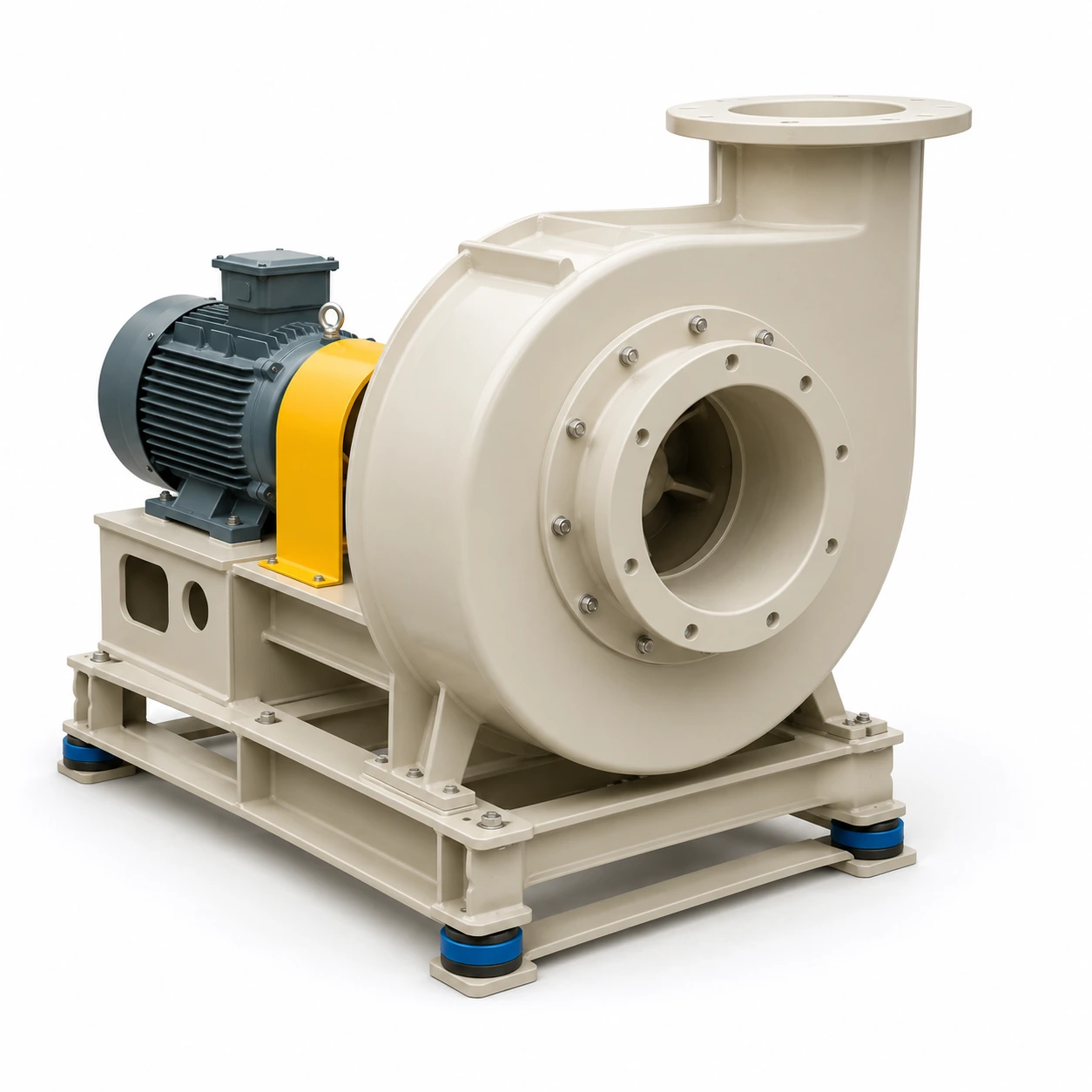
The QIYUE FAN polypropylene corrosion-resistant centrifugal fan is a project-configured plastic fan for selected corrosive exhaust systems including acid mist, alkaline vapor, laboratory exhaust, electroplating, pickling and wastewater treatment applications.
The casing, impeller, inlet cone and other gas-contact components can be fabricated from polypropylene homopolymer sheets and profiles. Airflow, pressure, fan speed, material thickness and reinforcement are selected according to the actual system duty.
Material selection should not be based only on the process name. Chemical composition, concentration, temperature, moisture, particles, solvents, oxidizing agents and exposure duration all affect whether PPH is suitable.
01 / MATERIAL
PPH Gas-Contact Construction
Selected gas-contact components can be fabricated from polypropylene according to the chemical duty.
02 / STRUCTURE
Plastic Welding Construction
Joint preparation, hot-air welding, sealing and reinforcement are part of the structural design.
03 / PROJECT
Duty-Based Configuration
Fan size, speed, drive arrangement, reinforcement and material scope should follow the actual operating duty.
02 / Typical Applications
Where PPH Corrosion-Resistant Fans Are Commonly Reviewed
01 / ACID MIST
Acid Mist Exhaust
Selected acid-mist collection and exhaust systems after compatibility review.
02 / ALKALINE
Alkaline Vapor Exhaust
Selected alkaline-vapor and corrosive humid-air applications.
03 / SURFACE TREATMENT
Electroplating & Pickling
Process exhaust from compatible electroplating and pickling lines.
04 / WATER TREATMENT
Wastewater Treatment
Corrosive odor and process exhaust in wastewater-treatment systems.
05 / LAB
Laboratory & Fume Hood
Laboratory exhaust where the actual chemical mixture is confirmed compatible.
06 / SCRUBBER
Wet Scrubber Systems
Can be reviewed downstream of wet treatment equipment when droplets, condensate and outlet chemistry are confirmed.
03 / Chemical Compatibility
Do Not Select PPH from the Process Name Alone
The exact chemical, concentration, temperature, moisture level, exposure time and mixed-media condition can materially change polypropylene suitability.
SELECTED ACIDS & ALKALIS
Common PPH Direction
Selected inorganic acids, alkaline vapor, salt solutions and compatible corrosive humid-air duties may support PPH construction after review.
OXIDIZING CHEMICALS
Detailed Review Required
Oxidizer type, concentration, temperature and exposure time can substantially change PPH suitability.
ORGANIC SOLVENTS
Not Automatically Suitable
Solvent swelling, extraction, stress cracking and permeation should be reviewed from exact chemical data.
MIXED OR UNKNOWN MEDIA
Testing or Supplier Review
Mixed waste gas, unknown contaminants, cleaning chemicals and changing process conditions require conservative verification.
04 / Engineering Boundary
Temperature, Impeller Diameter and Speed Must Be Reviewed Together
Lightweight plastic construction does not mean unlimited operating temperature or rotational speed.
01 / TEMPERATURE
Operating Temperature
Normal, peak and shutdown temperatures affect stiffness, welding integrity, creep and chemical compatibility.
02 / IMPELLER
Impeller Geometry
Diameter, blade form, hub design, reinforcement and balancing should match pressure and rotational speed.
03 / REINFORCEMENT
Structural Reinforcement
Casing ribs, flange support, base design and duct isolation should control deformation and external loading.
05 / Material Scope
Define the Plastic Gas Path Separately from the Drive and Support System
A PPH corrosion-resistant fan does not require every component to be made from polypropylene. The gas-contact scope and mechanical support scope should be defined separately.
POSSIBLE PPH GAS-CONTACT SCOPE
Corrosive Gas Path
Fan casing
Impeller and hub system
Inlet cone and discharge connection
Inspection cover and drain parts
Selected internal fasteners or sleeves
Transition pieces and wetted accessories
SEPARATELY SELECTED MECHANICAL SCOPE
Drive and Support Components
Base frame and external supports
Motor and coupling or belt drive
Bearing arrangement and shaft material
External fasteners and guards
Vibration isolators and base hardware
Electrical and instrumentation items
A PPH corrosion-resistant fan should define the gas-contact scope, structural scope and drive scope separately.
06 / Plastic Fabrication Control
Weld Quality Is Part of Corrosion Reliability
Material grade alone cannot compensate for poor preparation, welding, sealing or reinforcement.
01
Material Verification
Confirm PPH grade, sheet thickness and project documentation.
02
Joint Preparation
Control cutting, beveling, cleaning and fit-up before welding.
03
Hot-Air Welding
Match welding temperature, speed, pressure and filler material to the joint.
04
Sealing Inspection
Review weld continuity, corners, penetrations and possible leakage paths.
05
Impeller Balance
Balance the completed plastic impeller for the selected operating speed.
06
Final Assembly Review
Check alignment, clearance, fasteners, supports and vibration isolation.
Special Project Conditions
Standard PPH Is Not Every Project's Final Material
Flame-Retardant PP
Review project fire classification, indoor installation requirements and material documentation before selection.
Conductive PP
Conductive polypropylene may be considered where static accumulation and hazardous-vapor risk require separate review.
Outdoor Protection
UV exposure, rain, ambient temperature, support design and long-term weathering should be reviewed for outdoor installations.
07 / System Integration
Protect the Plastic Fan from Duct Loads and Liquid Carryover
01 / CONNECTION
Flexible Connections
Use suitable flexible connectors to isolate vibration and prevent duct expansion or misalignment from loading the casing.
02 / LIQUID
Drainage and Droplets
Review drain points, scrubber carryover, liquid accumulation, low points and cleaning procedures.
03 / SUPPORT
Base and Isolation
Select a stable base, vibration isolators and alignment method for the complete fan and motor assembly.
08 / Fan Platform & Configuration
Select Airflow and Pressure Before Finalizing the Plastic Structure
The product family can be configured for different low-to-medium pressure chemical exhaust duties.
ITEM
AVAILABLE DIRECTION
SELECTION BASIS
Fan Platform
Standard or custom centrifugal fan
Airflow, pressure, gas density and system resistance
Drive Arrangement
Direct, belt or coupling
Fan size, speed control, maintenance and installation
Motor Type
Standard, VFD-compatible or project motor
Power supply, hazardous area, speed range and control method
Material Option
PPH, flame-retardant or conductive PP direction
Chemical compatibility, fire, static and certification requirements
Material Selection Path
Compare PPH with FRP, Stainless Steel and Titanium
PPH Polypropylene
Selected acid mist, alkaline vapor, laboratory and medium-duty corrosive exhaust.
FRP Centrifugal Fan
Composite construction for compatible corrosive gas and broader fan-size requirements.
09 / Project Review Checklist
Send the Medium and Fan Duty Together
For a PPH fan project, chemical information is as important as airflow and pressure.
Chemical & Material Data
Gas composition: main and trace components
Concentration: normal and maximum
Temperature: normal, peak and shutdown
Moisture: humidity, droplets and condensation
Solvents / oxidizers: exact chemical names
Particles: loading, size, hardness and stickiness
Special requirements: fire, static, UV and certification
Fan & Installation Data
Airflow: normal and maximum duty
Pressure: static or total pressure
Fan position: before or after treatment equipment
Drive: direct, belt or coupling
Duct connection: flange, flexible joint and external load
Installation: indoor, outdoor, base and maintenance access
Control: fixed speed, VFD and hazardous-area requirements
Related Selection Paths
Build a Complete Corrosive Gas Exhaust System
10 / FAQ
PPH Corrosion-Resistant Fan Questions
Is PPH resistant to every acid and alkali?
No. Suitability depends on the exact chemical, concentration, temperature, exposure time and mixed-media condition.
Can a polypropylene centrifugal fan handle organic solvents?
Not automatically. Solvents may cause swelling, extraction, stress cracking or permeation and require separate review.
Is standard PPH flame-retardant or conductive?
Not necessarily. Flame-retardant and conductive polypropylene are separate project material directions that must be specified and documented.
Can PPH fans operate at unlimited speed because the impeller is lightweight?
No. Impeller diameter, rotational speed, operating temperature, stiffness, reinforcement and balance must be reviewed together.
Can the fan be installed after a wet scrubber?
Yes, when the outlet chemistry, droplet carryover, condensate, drainage and required fan pressure are confirmed.
What information is required for selection?
Provide airflow, pressure, chemical composition, concentration, temperature, moisture, particles, fan position, installation conditions and special material requirements.