01 / Product Overview
Material-Based Centrifugal Fan Configuration
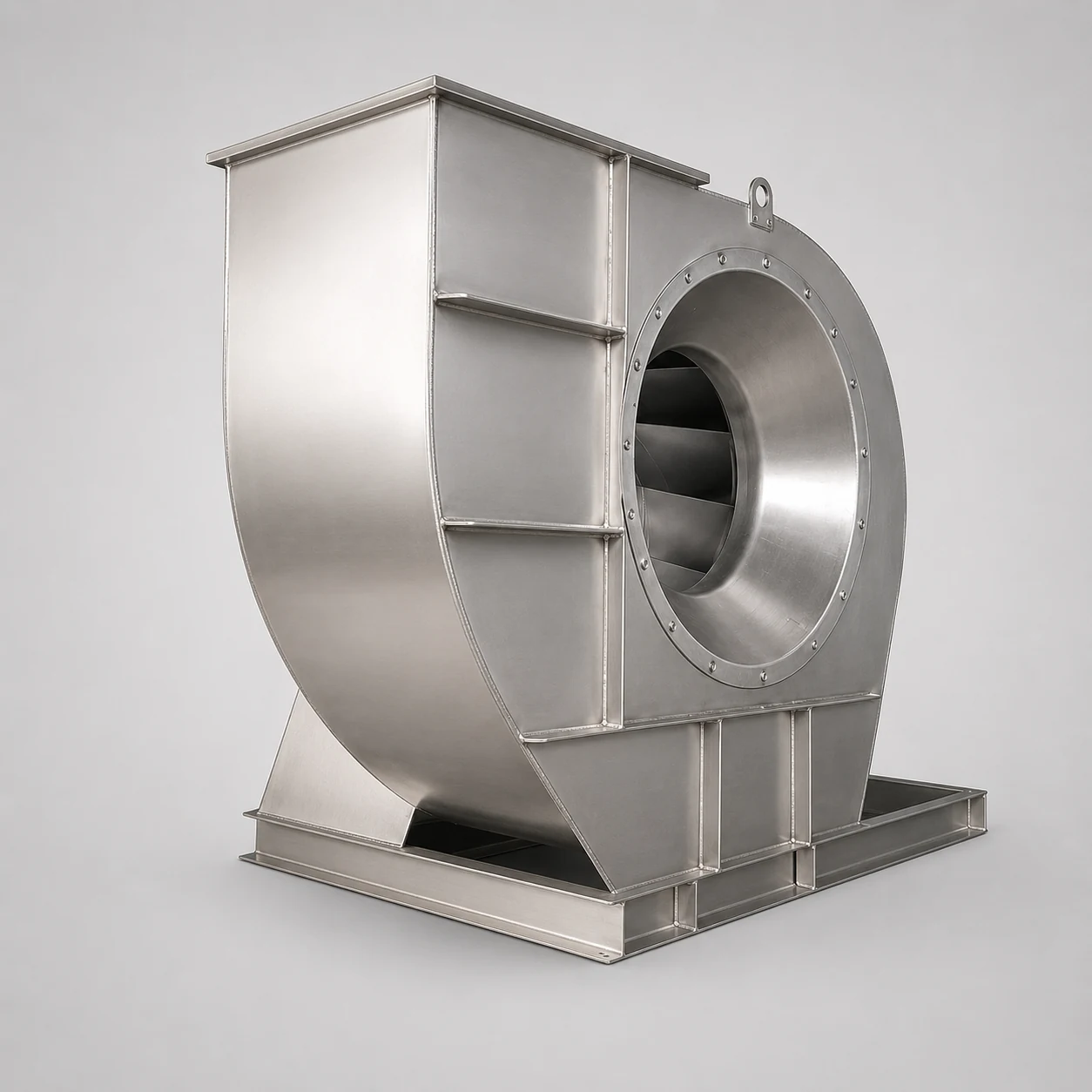
The QIYUE FAN 304 Stainless Steel Corrosion-Resistant Centrifugal Fan is intended for ventilation systems where ordinary carbon steel may be affected by moisture, surface rust or mild chemical exposure.
This is not one fixed fan model. The final centrifugal fan platform is selected according to airflow, total pressure, gas composition, operating temperature, dust content, installation arrangement and required drive type.
Depending on the project, the casing, impeller, inlet cone and other gas-contact components can be manufactured from 304 stainless steel. Full stainless construction, stainless gas-contact parts and hybrid material configurations can be reviewed.
304 stainless steel should be treated as a starting material direction for humid and mildly corrosive service, not as a universal solution for every chemical exhaust condition.
Material boundary: chloride exposure, salt spray, strong acids or alkalis, continuous condensation, scrubber-liquid carryover and unknown mixed gas should trigger a separate material review.
02 / Material Positioning
Why Use 304 Stainless Steel?
304 stainless steel provides a practical material direction between painted carbon steel and higher-alloy or non-metallic corrosion-resistant construction.
01 / MOISTURE
Moisture Resistance
Better resistance to atmospheric rust and humid operating environments than ordinary painted carbon steel.
02 / FABRICATION
Fabricated Structure
Suitable for fabricated casings, impellers, inlet cones and project-specific welded fan components.
03 / SURFACE
Clean Metallic Surface
Provides a durable and cleanable metallic surface for selected food, pharmaceutical and clean manufacturing environments.
04 / SCOPE
Flexible Material Scope
Can be configured as full stainless steel, selected gas-contact parts or a cost-controlled hybrid structure.
03 / 304 vs 316L
Do Not Treat All Stainless Steel as the Same Material
The stainless grade should follow the actual gas, condensate and cleaning environment. Upgrading to 316L can improve resistance in many wet and chloride-related conditions, but it still does not guarantee compatibility with every chemical medium.
304 STAINLESS STEEL
Humid and Mildly Corrosive Service
A practical direction for humid process air, cleaner exhaust and selected mild chemical exposure where chloride and condensate risks are controlled.
Review: atmospheric moisture, cleaning chemicals, condensate chemistry, weld condition and gas-contact scope.
316L STAINLESS STEEL
More Demanding Wet or Chloride-Risk Duty
Often reviewed where the fan sees wet process gas, scrubber exhaust, chloride-containing condensate or more demanding cleaning conditions.
Review: chloride concentration, temperature, crevices, droplets, reducing acids and shutdown condensation.
Compare 316L Stainless Steel Fan →
Escalate beyond stainless steel when required: strong acids or alkalis, severe oxidizing chemistry, high-purity service, wet chlorine, seawater-related duty or unknown mixed exhaust may require PPH, PVDF, FRP, titanium or another verified material.
04 / Material Scope
Define Exactly Which Components Use 304 Stainless Steel
"Stainless steel fan" is not a sufficiently precise specification. The material scope should be defined component by component according to the gas-contact boundary and project requirements.
OPTION 01
Full 304 Construction
Casing, impeller and principal structural gas-contact components use 304 stainless steel. Purchased mechanical components remain subject to separate material confirmation.
OPTION 02
304 Gas-Contact Parts
Components directly exposed to the conveyed gas use 304 stainless steel while external supports, bearing pedestals and non-contact structures can remain carbon steel.
OPTION 03
304 Casing + Impeller
The two principal gas-handling components use stainless steel while the base, transmission support and motor arrangement use conventional industrial materials.
OPTION 04
Hybrid Material Construction
Different components can use different materials according to corrosion exposure, gas-contact boundaries, structural requirements and project budget.
05 / Main Components
Project-Configured Fan Construction
Fan Casing
Welded stainless steel casing with project-specific plate thickness, external reinforcement, inlet flange, discharge flange, inspection opening, drainage and lifting provisions.
Impeller
Backward-curved, forward-curved or radial blade construction is selected according to airflow, pressure, efficiency, gas cleanliness and dust condition.
Inlet Cone
The stainless inlet cone guides airflow into the impeller eye. Correct alignment and inlet clearance support stable aerodynamic performance.
Shaft and Sleeve
Shaft material follows torque, speed and mechanical load. Stainless sleeves can be provided where exposed shaft sections require corrosion protection.
Base and Support
Carbon steel, coated steel or stainless steel base structures can be reviewed according to environmental exposure and project requirements.
Drive Arrangement
Direct, belt or coupling drive can be selected according to fan size, speed, temperature, maintenance requirements and motor position.
06 / Application Boundary
Where 304 Should - and Should Not - Be the First Material Choice
TYPICAL SELECTION DIRECTION
Applications to Consider
Humid Industrial Ventilation
Workshops, washing areas, utility ventilation and process areas exposed to moisture.
Cleaner Process Exhaust
Low-dust and mildly corrosive industrial exhaust streams.
Food & Pharmaceutical Utility Exhaust
Applications where a cleanable metallic construction is preferred.
Equipment & Enclosure Ventilation
Air extraction from process equipment and humid machinery enclosures.
Selected Mild Chemical Exhaust
Only after reviewing composition, concentration, temperature and condensate.
MATERIAL WARNING
Conditions Requiring Separate Review
Chlorides and Salt Spray
May require 316L, duplex stainless steel, titanium or another confirmed material.
Strong Acids or Alkalis
Chemical type, concentration, temperature and water content must be supplied.
Continuous Condensation
Condensate may be more corrosive than the original gas stream.
Abrasive or Sticky Dust
Corrosion resistance does not automatically provide wear resistance.
Elevated Temperature
High-temperature duty requires separate thermal and structural review.
08 / Technical Configuration
Available Project Options
Fan Material
Full 304 stainless steel or selected gas-contact components
Fan Type
Customized centrifugal fan
Impeller Type
Backward-curved, forward-curved or radial, subject to duty
Airflow & Pressure
Selected according to the system operating point
Drive Arrangement
Direct, belt or coupling drive
Rotation & Outlet
Clockwise or counterclockwise with project-specific discharge angle
Motor
Standard, variable-frequency or explosion-proof motor
Accessories
Damper, flexible connector, vibration isolator, guard, inspection door and drain
09 / Material Selection
Select Material from the Actual Medium
Higher material cost does not automatically mean better suitability for every gas composition. Use the actual chemistry, moisture, temperature and condensate condition to establish the material direction.
Painted Carbon Steel
Direction: dry, non-corrosive industrial air.
Watch: coating damage can expose the base steel.
304 Stainless Steel
Direction: humid and mildly corrosive air.
Watch: severe chloride and strong chemical conditions.
316L Stainless Steel
Direction: more demanding wet or chloride-risk environments.
Watch: chemical compatibility still requires review.
FRP
Direction: compatible corrosive chemical exhaust.
Watch: temperature, abrasion and structural loading.
PPH Polypropylene
Direction: selected acid mist, alkaline vapor and chemical exhaust.
Watch: solvents, oxidizers, temperature, stiffness and static risk.
PVDF Fluoropolymer
Direction: selected severe chemical, oxidizing or high-purity exhaust.
Watch: resin grade, strong alkalis, welding and temperature.
Titanium
Direction: selected severe project-specific corrosive media.
Watch: high material and fabrication cost.
This comparison is a material-selection direction only and should not be treated as a chemical compatibility chart.
Manufacturing & Inspection
Material Control Must Continue Through Fabrication
Stainless steel selection alone does not guarantee a reliable fan. Fabrication, balancing, alignment and final inspection remain essential.
01
Material Identification
Confirm grade, plate thickness, component scope and required certificates before production.
02
Forming & Welding
Control casing geometry, weld sequence, heat input, deformation and internal surface condition.
03
Impeller Balancing
Balance the fabricated impeller after welding and dimensional inspection according to agreed acceptance criteria.
04
Final Inspection
Check dimensions, rotation, shaft alignment, trial operation, vibration and packing before shipment.
Project Selection Data
Send the Operating Conditions, Not Only the Material Name
Airflow and pressure determine the fan platform. Gas composition and operating conditions determine whether 304 stainless steel is suitable.
01 / PERFORMANCE
Fan Duty
Airflow
Static or total pressure
System resistance
Adjustment range
Continuous operating time
02 / GAS
Gas Conditions
Complete gas composition
Chemical concentration
Normal and maximum temperature
Humidity and condensation
Dust concentration and particle size
03 / INSTALLATION
Installation Data
Indoor or outdoor installation
Inlet and discharge arrangement
Available equipment space
Rotation direction
Foundation and duct dimensions
04 / MATERIAL
Material Scope
Full stainless construction
Casing and impeller only
Gas-contact parts only
Surface treatment requirements
Material certificate requirements
Related Selection Paths
Continue from 304 to the Correct Material Direction
10 / Buyer FAQ
304 Stainless Steel Fan Questions
Is a 304 stainless steel fan suitable for acid gas?
Suitability depends on acid type, concentration, temperature, moisture and condensate. 304 should not be assumed suitable from the phrase "acid gas" alone. Another stainless grade, PPH, PVDF, FRP or another material may be required after compatibility review.
What is the difference between 304 and 316L?
316L is generally reviewed for more demanding wet, chloride-containing or scrubber-exhaust conditions because of its improved resistance compared with 304. Neither grade is universally suitable for every corrosive medium.
Can only the impeller be manufactured from 304 stainless steel?
Yes, but every component exposed to the gas should be reviewed. A stainless steel impeller alone does not protect the casing, inlet cone or other exposed components.
Is this product limited to the 4-72 fan platform?
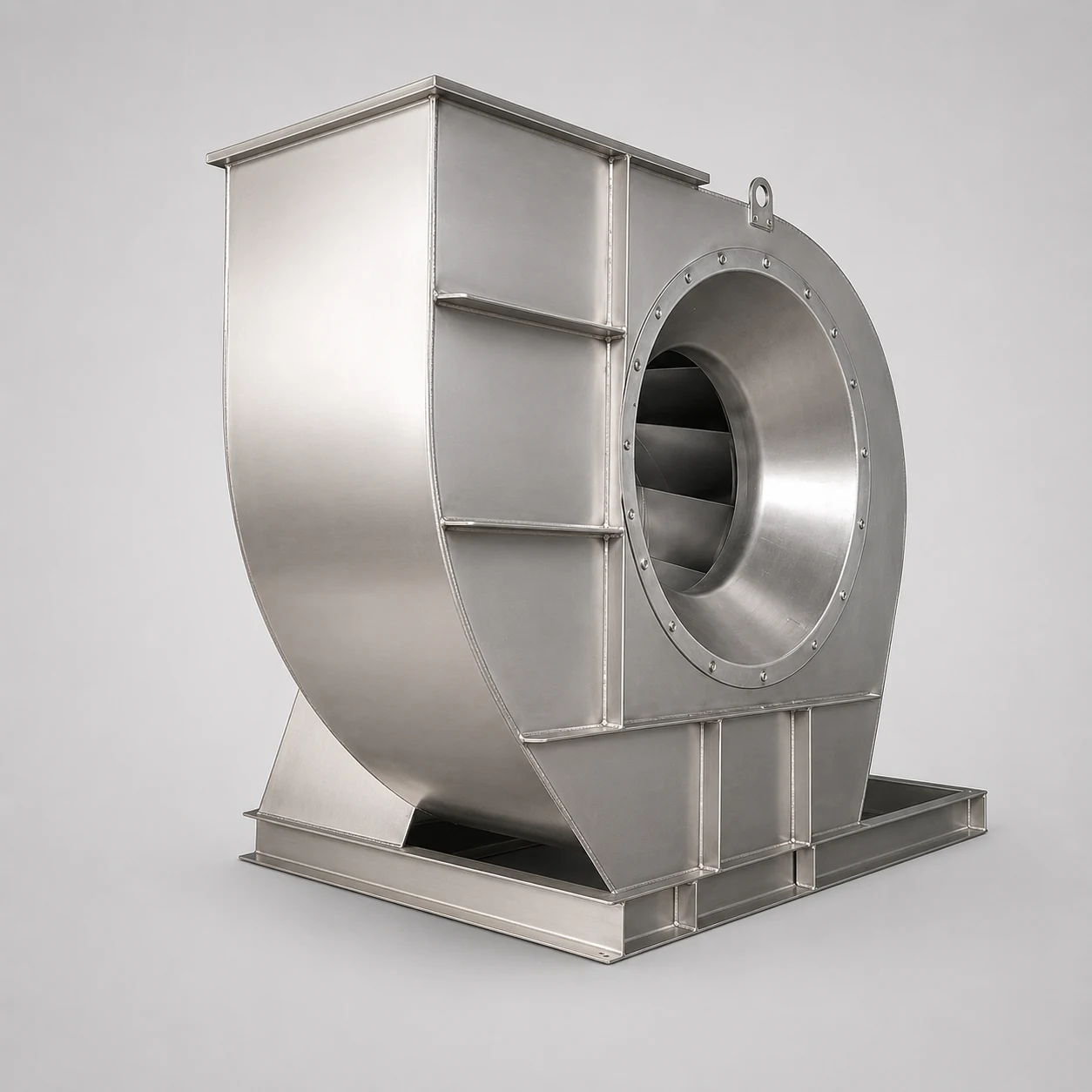
No. The displayed fan represents one possible structure. Stainless steel construction can be applied to different centrifugal fan platforms according to airflow and pressure.
Can an explosion-proof motor be supplied?
Yes. Provide the hazardous-area classification, gas group, temperature class, electrical standard and power supply so the motor requirement can be reviewed.
Can material certificates and performance curves be supplied?
Material certificates can be supplied when specified before production. A performance curve can be prepared after the final fan size, speed and duty point are confirmed.