

Select the Pump-Room Fan from the Room Duty - Not the Fan Diameter
An industrial pump room, an offshore utility pump space and a shipboard cargo pump-room can look similar, but they do not share one universal ventilation specification. Establish the room purpose, cooling or contaminant-removal duty, airflow path, system resistance, electrical environment and required approvals before selecting a fan model.
01. Identify the Actual Pump-Room Service
Industrial water and utility pump rooms: often focus on motor heat removal, humidity control and fresh-air exchange. A suitable axial-flow fan can be considered for larger airflows at lower duct resistance, subject to its actual fan curve.
Coastal and offshore utility pump spaces: may add saline humidity, coatings, corrosion risk, weather protection and restricted maintenance access. An offshore location alone does not define a hazardous-area classification or certify a fan for marine service.
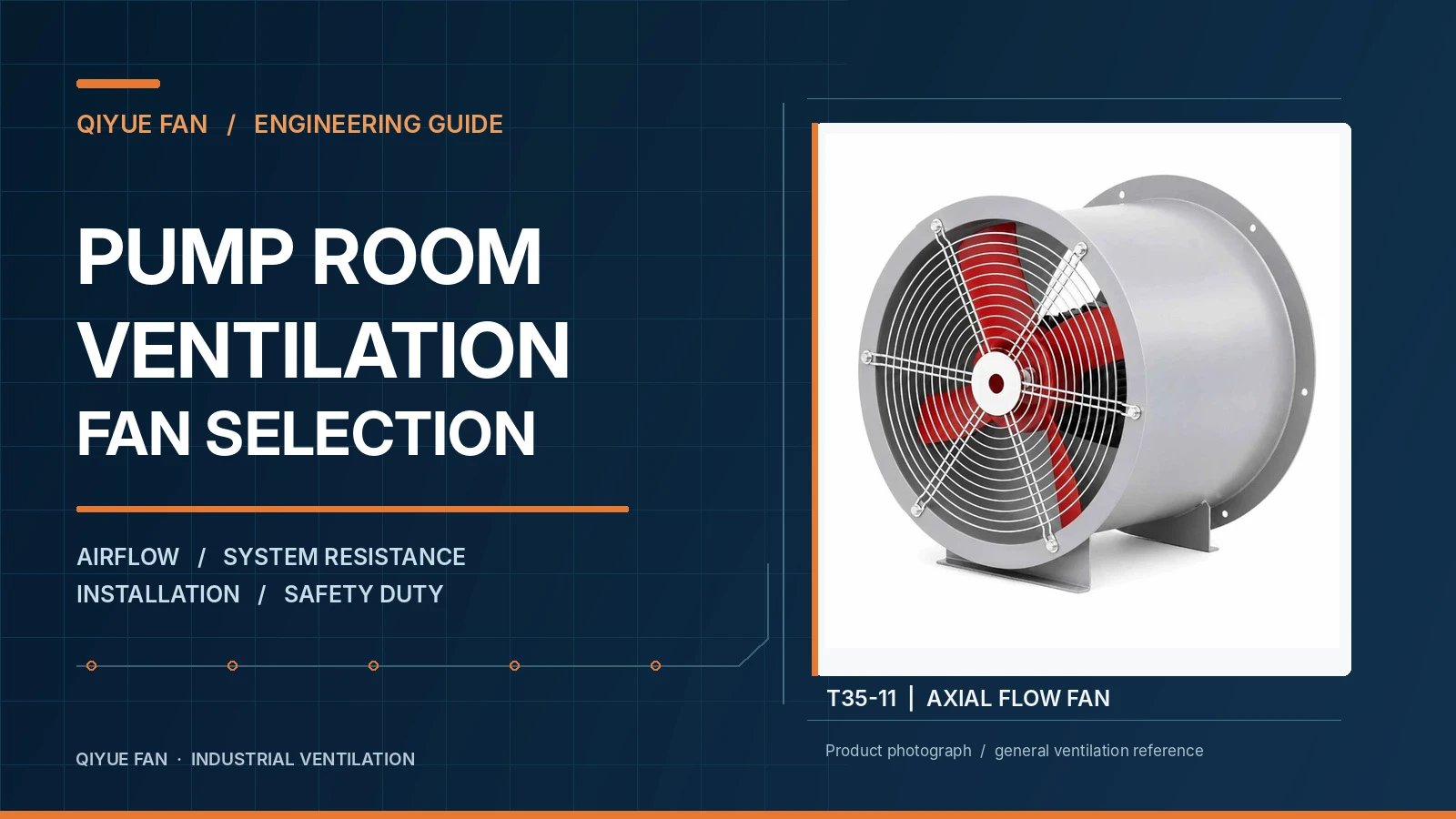
Vessel cargo pump-rooms and other flammable-vapor spaces: require a different regulatory and engineering review. They may require extraction-type ventilation, non-sparking fan construction, safe discharge, gas detection and approval of the complete equipment configuration. Do not apply a generic T35-11 product photo or catalogue statement as evidence of compliance.
An Ex motor does not make a complete fan marine-approved.
Where the room is classified or serves a regulated cargo system, confirm the vessel type, applicable SOLAS/IBC/IGC provisions, class and flag requirements, gas group, temperature class, non-sparking construction, duct position and required certificates before quoting a suitable fan.
02. Trace the Ventilation Route and Actual System Resistance
The equipment-room airflow route should be established before selecting diameter, motor power or number of fans. Check fresh-air intake, air circulation across heat sources, exhaust pickup, ducts and the final discharge point. A fan rated at free delivery may not provide the required airflow after it is connected to dampers, louvers, screens and bends.
Use the required operating airflow at the installed system pressure when evaluating a fan performance curve. See the QIYUE guides to fan performance curves and static versus total pressure for the pressure definitions needed in a quotation.
03. Choose an Existing Fan Family Without Overstating Its Scope
For clean-air, ordinary industrial utility rooms, an axial-flow option can be appropriate when airflow is relatively high and pressure demand remains low. Long ducts or restrictive components may shift the duty toward a centrifugal or another engineered fan arrangement. Selection must be checked at the actual operating point.


For more restrictive systems or special working media, review QIYUE centrifugal fans, corrosion-resistant fans and explosion-proof fan families. These are selection directions only; project-specific suitability and certificates remain subject to verification.
04. Account for Corrosion, Hazardous Areas and Standby Operation
Do not use one universal air-change rate for all pump rooms. For example, SOLAS II-2/4.5.4 specifies at least 20 air changes per hour for cargo pump-rooms within its scope, while IBC Code Chapter 12.1 specifies at least 30 air changes per hour for applicable chemical-cargo spaces. Which rules apply-and whether higher requirements govern-must be established by the responsible designer and project authority. These figures are not generic sizing rules for ordinary industrial pump rooms.
Likewise, duty/standby requirements may be imposed by a plant owner, project specification, class rule or operating risk study. Confirm whether specified quantities refer to installed fans, continuously operating fans or standby units before preparing a quotation.
05. Pump-Room Ventilation Fan RFQ Checklist
A useful technical inquiry does not have to include a completed fan model. It should identify what is already defined and what remains with the EPC designer, equipment owner or classification authority.
| RFQ item | Buyer should provide | Reason |
|---|---|---|
| Room and service | Onshore utility, offshore utility, vessel machinery or classified cargo pump-room | Determines duty and applicable safety regime |
| Design airflow | Required m³/h; basis, operating modes and reserve philosophy | Fan airflow at duty point |
| Pressure basis | Required Pa; static vs total; duct, grille, louver and damper losses | Match system curve and fan performance |
| Atmosphere | Temperature, humidity, salt, vapor or chemical constituents | Material, coating and motor protection |
| Hazardous-area review | Zone/class, gas group, temperature class, vessel rules and required approval | Complete equipment suitability; not just an Ex motor |
| Power supply | 380/400 V or project voltage, 50/60 Hz, phases, IP, insulation and controls | Motor and speed compatibility |
| Installation and layout | Duct diameter, flange, wall/floor location, airflow direction, access | Mechanical integration |
| Operation | Continuous/intermittent, duty/standby, alarms, noise target | Reliability and equipment scope |
| Documents and quantities | GA drawings, fan curve, test basis, certification, quantity, delivery destination | Quotation and submittal package |
06. Common Buyer Questions
Can a general-purpose axial fan be installed in an offshore pump room?
It may be considered for a suitable, non-classified utility-room duty only after environmental, airflow, pressure and installation reviews. Offshore location does not by itself prove that the fan needs or holds marine approval.
Does an explosion-proof motor alone satisfy cargo pump-room requirements?
No. The complete fan system, non-sparking construction, electrical installation, materials, ventilation route and required documentary approvals must match the actual application and applicable rules.
Can I select the fan by air changes per hour alone?
No. The relevant design standard must first establish airflow; the installed system also requires pressure calculation, duty-point verification and checks of room circulation and air discharge.
Why is a 400 V / 50 Hz or 380 V / 60 Hz requirement important?
Supply voltage and frequency can change motor selection and speed, which changes the fan operating point. The project must specify the actual electrical supply and acceptable motor/drive configuration.
Can QIYUE quote if the customer has no final fan model?
Yes, a preliminary technical review can start from a room plan, airflow, pressure estimate, environmental conditions, site photos and required quantity. Missing approvals or safety parameters must remain explicitly pending rather than assumed.
Send the Duty Point and Installation Requirements
Share room and service type, required airflow and pressure, duct layout, temperature, medium, corrosion conditions, voltage and frequency, quantity and destination. For regulated hazardous or marine service, identify the exact approval and document scope.
Start Technical Fan Selection →Regulatory source references for engineering review (not a QIYUE product approval): SOLAS II-2 and IBC Code, Chapter 12.1. Applicable editions and project authority must be checked before design approval.