
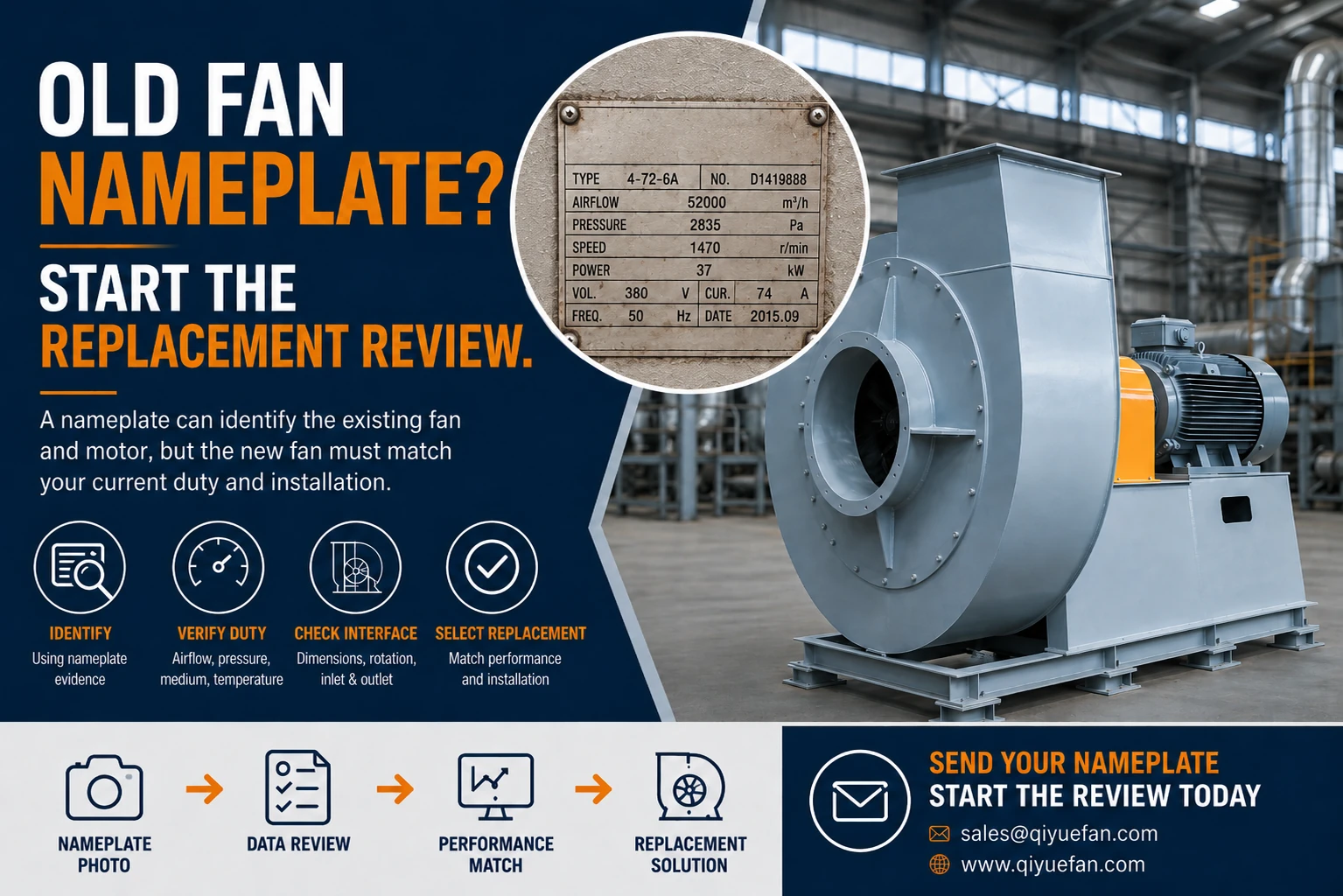
A Nameplate Identifies the Old Fan - It Does Not Define the New Fan
When an existing industrial fan needs to be replaced, the nameplate is often the first piece of information available. A clear plate can help identify the fan series, model, size, rated speed, motor power, electrical reference, manufacturer and serial information.
That answers the first question: What equipment is currently installed?
The next question is more important: What does the system require now? Ducts, filters, process demand, temperature and system resistance may have changed since the old fan was installed.
Helps Identify the Old Fan
Size
RPM
Motor power
Voltage
Frequency
Manufacturer
Serial / tag
Defines What the New Fan Must Do
Pressure
Medium
Temperature
System resistance
Installation interface
Rotation / outlet
Available space
A Nameplate Can Be Correct and Still Be Used Incorrectly
Most replacement errors do not happen because the nameplate is wrong. They happen because one value is interpreted as something it does not actually represent.
Motor RPM = Fan RPM
Not always. On a belt-driven fan, motor speed and fan shaft speed can be different. Pulley ratio, drive arrangement and the original curve should be checked.
Motor kW = Fan Capacity
The same motor power can support very different airflow, pressure, speed and efficiency combinations. Matching motor kW does not reproduce the fan duty.
Same Model = Same Performance
A model family can have different sizes, speeds, drive arrangements, motors and outlet directions. Model recognition starts verification; it does not finish selection.
Old Data = Current Requirement
Filters, ducts, branches, dampers and process demand may have changed. A like-for-like copy can reproduce an old system problem.
Pressure Value Without Definition
A value such as 1200 Pa is incomplete unless the project confirms whether it is static pressure, total pressure or another measured value.
What Different Nameplates Actually Tell Us
The examples below show why fan-plate data, motor-plate data and customer-supplied old-equipment evidence should be read together rather than treated as interchangeable information.
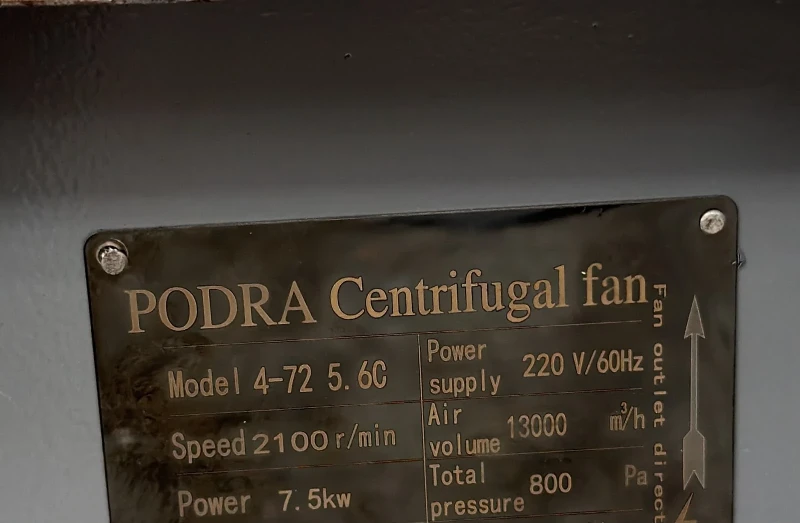
The Fan Plate Does Not Describe the Entire System
Current Airflow & Pressure
The old plate may show historical values, but the present system resistance and required duty still need to be confirmed.
Gas, Dust & Corrosion
Dust concentration, moisture, corrosive chemistry, abrasive particles and flue-gas conditions are often absent.
Normal & Maximum
Current process temperature may differ from the condition used when the old fan was originally selected.
Inlet · Outlet · Foundation
Nameplates normally do not provide the physical interfaces needed to confirm a drop-in replacement.
Combine Equipment Evidence with Current Duty Data
Identify What Is Installed
Motor nameplate
Fan photos
Old model
Serial / equipment tag
Verify the Original Equipment
Performance curve
Datasheet
Old catalog page
As-built drawing
Define What the New Fan Must Do
Required pressure
Medium & temperature
Inlet / outlet
Foundation & available space
Replacement Selection Should Move from Identification to Verification
Identify
Verify
Recheck
Match
Select
Real Replacement Engineering Combines Multiple Sources
What Additional Identification Should Be Checked for an EAC Fan?
For industrial fans supplied into an EAEU project under an applicable conformity route, the nameplate is also part of the equipment-identification and conformity chain. The marking should correspond to the actual fan and its supporting technical documents.
Manufacturer Identification
Manufacturer name and address should identify the company responsible for manufacturing the equipment.
Model & Traceability
Product name, model, serial number and manufacturing date should correspond to the actual fan and project technical file.
Technical Data & EAC Mark
Main technical parameters and the EAC mark should be clearly displayed. The EAC symbol height should be no less than 5 mm.
Industrial Fan Nameplate FAQ
Can I replace an industrial fan using only the nameplate?
Usually not. The nameplate helps identify the old equipment, but replacement selection should also verify airflow, pressure, speed, medium, temperature and installation interfaces.
Is motor kW enough to identify the required fan?
No. The same motor power can support different fan models, speeds, airflow and pressure points. Motor kW is supporting information, not the main selection parameter.
What if the fan nameplate is missing or unreadable?
Send fan photos, motor plate data, inlet and outlet dimensions, foundation measurements, rotation, discharge direction and any available old drawing or curve.
Why can the replacement fan be different from the original model?
Because the new fan should satisfy the current duty and installation requirements. A different internal design can be acceptable when performance and required interfaces are correctly matched.
Is the EAC mark enough to select a replacement fan?
No. EAC marking relates to conformity and equipment identification. Replacement engineering still requires the actual airflow, pressure, operating condition and installation interfaces.
Should the nameplate match the technical passport and drawing?
Yes. Model, serial information and relevant technical data should remain consistent across the physical equipment and the final project documentation.
Continue from Identification to Verified Selection
Motor Poles & RPM
Separate motor speed from actual fan speed and review 50Hz / 60Hz effects.
Read RPM guide →Static vs Total Pressure
Confirm the pressure definition before using an old value for a new fan selection.
Read pressure guide →GA Drawing Review
Verify dimensions, interfaces and installation risks after the old fan has been identified.
Read GA guide →Replacement & Spare Parts
Move from old-equipment evidence to replacement fan and spare-parts review.
Open replacement guide →Send the Nameplate - but Send the System Data Too
Send the fan nameplate, motor plate, old drawing, fan photos and the current airflow and pressure requirement. QIYUE FAN can review the old equipment together with the present operating condition before proposing a replacement.


