

Understanding Centrifugal Airflow Before Fan Selection
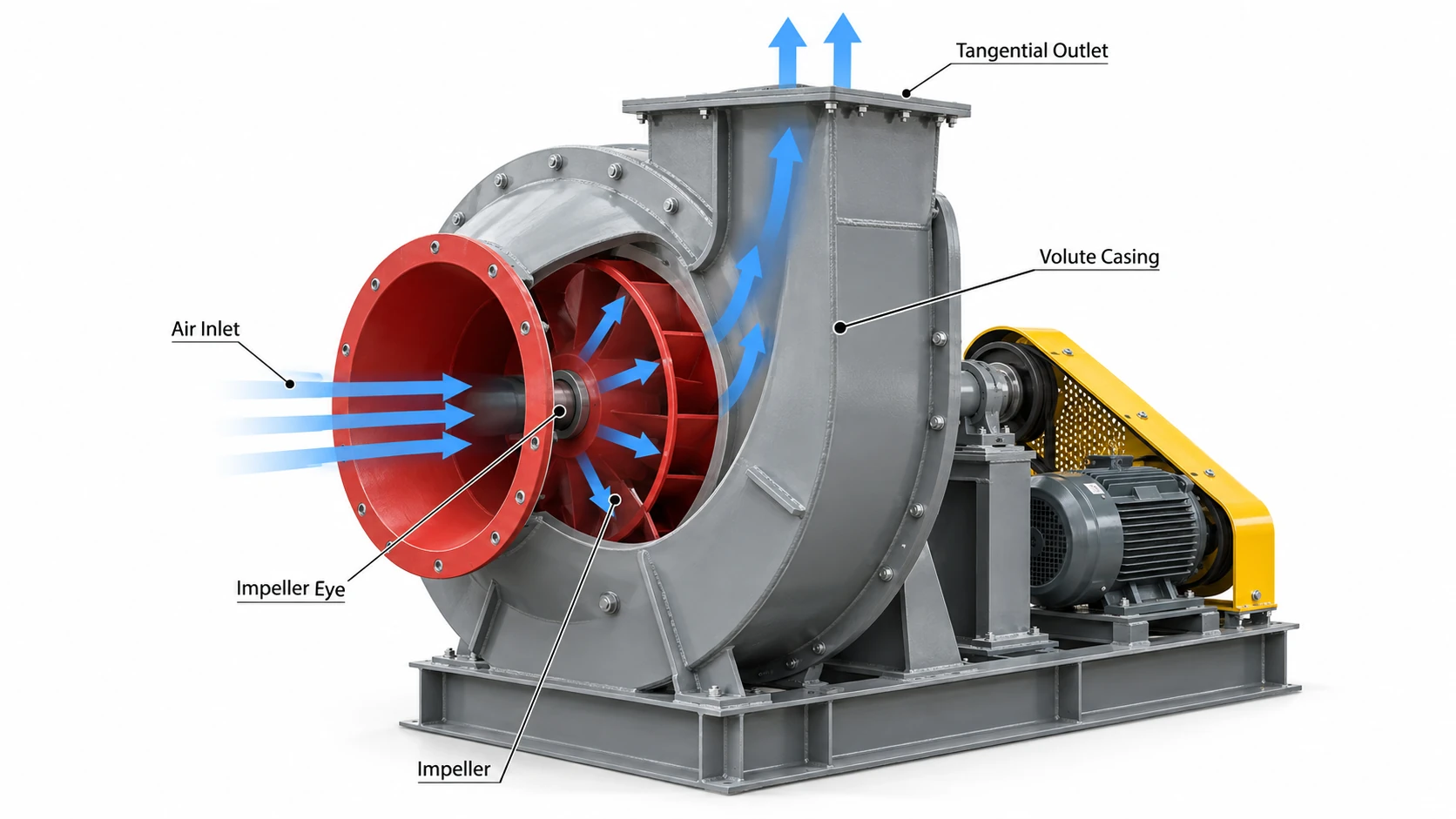
A centrifugal fan draws air into the center of a rotating impeller, transfers energy to the airflow and redirects the air outward through the wheel before the casing guides it toward the discharge.
This guide explains how a centrifugal fan works, the airflow path through the impeller and volute, the main impeller types, pressure characteristics, industrial applications and the information required before fan selection.
What Is a Centrifugal Fan?
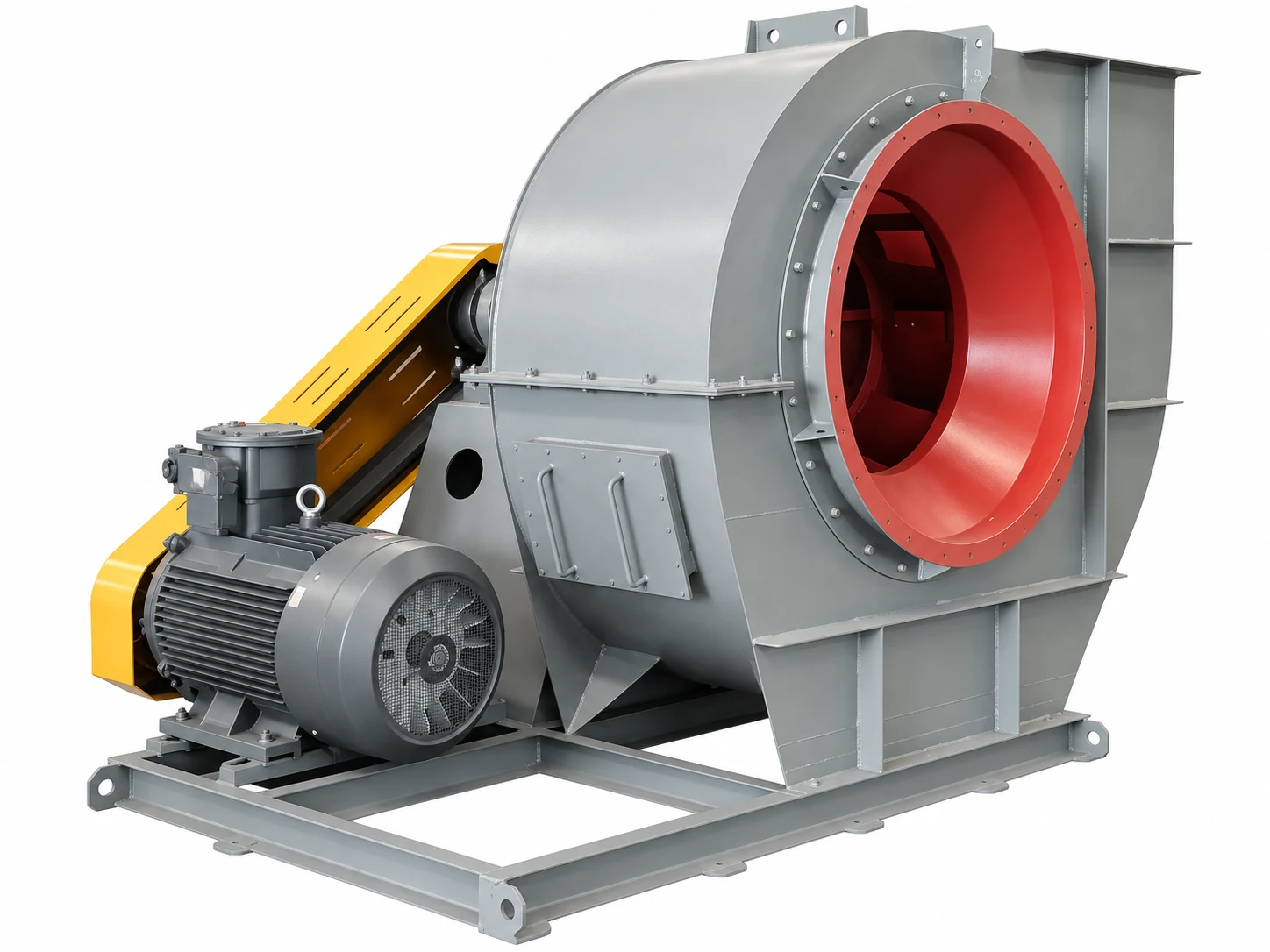
A centrifugal fan is a rotating air-moving machine in which air enters near the center, or eye, of the impeller and is accelerated outward through the rotating wheel. The surrounding casing collects this airflow and directs it toward the fan outlet.
Unlike an axial fan, where the main airflow direction remains approximately parallel to the fan shaft, a centrifugal fan changes the airflow direction as it passes through the impeller and casing.
How Air Moves Through a Centrifugal Fan
Air normally enters near the impeller eye in an approximately axial direction. As the impeller rotates, the airflow receives energy and moves from the center toward the outer diameter of the wheel. After leaving the impeller, the air enters the expanding volute, where it is collected and directed toward the tangential discharge outlet.
How Does a Centrifugal Fan Work?
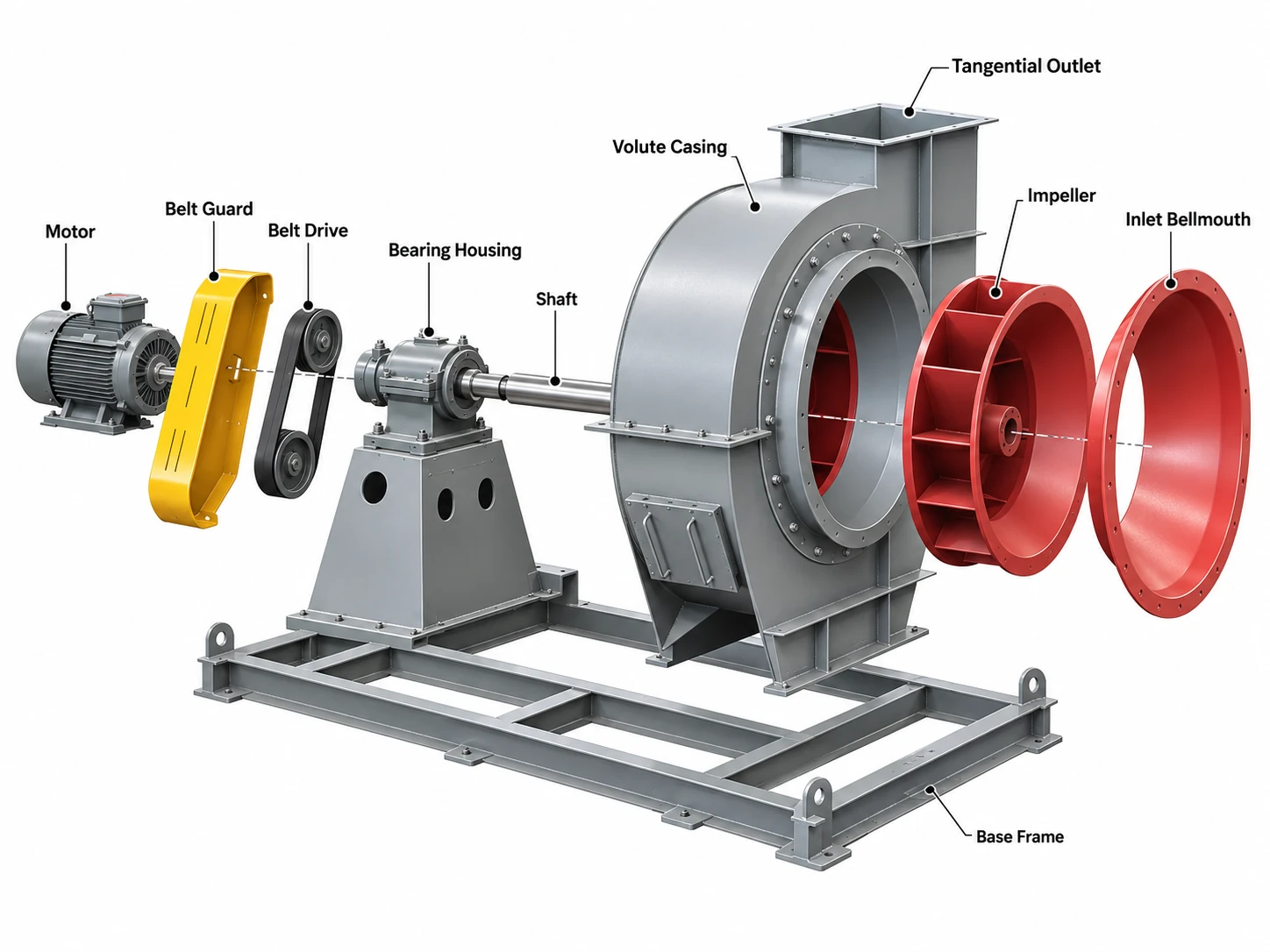
The motor turns the impeller through a direct, belt or coupling-connected drive. The rotating blades transfer mechanical energy to the airflow. The casing then collects the air leaving the wheel and directs it toward the system.
Main Parts of an Industrial Centrifugal Fan
Forward-Curved, Radial and Backward-Curved Impellers
Blade outlet geometry affects airflow, pressure, efficiency, power characteristics and suitability for dust or particles. Final selection must still be based on the actual fan curve and working medium.
Airflow & Pressure Characteristics
Compared with many general ventilation axial fans, centrifugal fans are commonly selected where the system requires greater pressure capability or where airflow must overcome ducts, filters, collectors, boilers or process equipment.
Centrifugal Fan vs Axial Fan
The most visible difference is the airflow path, but selection should not be based on airflow direction alone. Pressure, resistance, space, efficiency, noise, medium and installation conditions must also be considered.
| Comparison | Centrifugal Fan | Axial Fan |
|---|---|---|
| Air Entry | Usually enters near the impeller eye along the shaft direction. | Enters along the main fan axis. |
| Airflow Through Fan | Moves outward through the impeller and exits through the casing outlet. | Remains mainly parallel to the fan axis. |
| Typical Structure | Impeller with volute or scroll casing. | Propeller, tube-axial or vane-axial structure. |
| Pressure Direction | Often selected for moderate to high system resistance depending on design. | Ranges from general ventilation to specialized higher-pressure designs. |
| Typical Applications | Ducts, dust collection, boilers, process air and conveying. | Ventilation, cooling, tunnels and large-volume airflow. |
Where Are Industrial Centrifugal Fans Used?
Centrifugal fans are used across many industrial processes. The fan series, impeller geometry, material and drive arrangement must be matched to the real working condition.
When Is a Centrifugal Fan the Better Direction?
A centrifugal fan becomes a strong candidate when the system requires pressure capability, process resistance or medium-handling characteristics not well matched by a general axial ventilation fan.
What Information Is Required to Select a Centrifugal Fan?
Fan model selection should come after the operating point and working condition are defined. For replacement projects, existing drawings, nameplates and installation dimensions are also useful.
Required m³/h or m³/s.
Static / total pressure and system resistance.
Clean air, dust, gas, fumes or particles.
Normal air or elevated-temperature gas.
Ducts, filters, collectors and resistance.
Drive arrangement, rotation and outlet position.
Power, voltage, frequency and protection.
Quantity, destination and document requirements.
Continue from Fan Fundamentals to Engineering Selection
Frequently Asked Questions About Centrifugal Fans
Send the Operating Point Before Choosing the Fan Model
Send the application, airflow, pressure, temperature, medium condition, system resistance, voltage, frequency, installation direction, quantity and destination. QIYUE FAN can review the suitable centrifugal fan family and configuration before quotation.